Practical · Money and payments
Paying in China: Alipay, WeChat Pay and what they cost
Alipay and WeChat Pay both take foreign cards: free up to 200 yuan, 3% above. The official spending limits, the cash rule and whether you really need both apps.
thechinaatlas.com/en/paying-in-china

In this article
Most visitors pay in China the way residents do: by scanning a QR code with Alipay or WeChat Pay. Both apps accept a foreign Visa or Mastercard, and both open with a foreign phone number. Small payments cost nothing extra and larger ones carry a fee, which is where a card presented at a terminal, or a few hundred yuan in cash, earns its place in your wallet.
How do people actually pay in China?
There are four ways to pay, and they work best combined.
| Works with a foreign card | Extra cost | Where | |
|---|---|---|---|
| Alipay | yes, linked in the app | 3% above 200 yuan, as reported | tills, stalls and taxis showing its code |
| WeChat Pay | yes, linked in the app | 3% above 200 yuan | tills, stalls and taxis showing its code |
| Cash in yuan | withdrawn at an ATM | your bank’s withdrawal fee | anywhere, by law |
| Visa or Mastercard | presented directly | your bank’s foreign-currency fee | hotels and shops showing the logo |
Updated:
Alipay
Alipay is the payment app of Ant Group. Foreign visitors link an international card, and the app pays merchants from it in yuan. Alipay is available in 16 languages, English, French, German and Italian among them, according to the Beijing municipal government. It accepts Visa, Mastercard, JCB, Diners Club and Discover, according to the same government’s payment guide.
WeChat Pay
WeChat Pay sits inside the WeChat messaging app and is run by Tenpay. Its rules for foreign cards are published on WeChat’s own help page, checked on 7 October 2026: which documents are accepted, which limits apply, what a foreign card can and cannot do. For a visitor, that page is the clearest official statement either app has made.
Cash
Banknotes in yuan remain legal tender, and a 2020 announcement by the central bank forbids any business or person to refuse them. In practice cash is the backup that never depends on a battery, a network or a card issuer. A few hundred yuan cover taxis, small shops and the occasional stall where the code will not scan.
Bank cards
A foreign Visa or Mastercard works directly where the merchant displays its logo, according to the official payment guide published by Beijing’s municipal government. In practice that tends to mean hotels and larger shops; the logo at the till is what decides. UnionPay cards are accepted at every card terminal on the mainland.

How do you set up Alipay and WeChat Pay?
Both apps follow the same pattern: an account opened with your phone number, a foreign card added, and your passport when the app asks for it. Both take cards on the same networks: Visa, Mastercard, American Express, JCB, Discover and Diners Club, and UnionPay. Payment works the same way in both: you scan the merchant’s code, or you show yours for the merchant to scan.
Alipay
Download the app, choose English or another language, and register with your phone number. Alipay is reported to accept foreign numbers. Add your card in the bank card section of the app. Identity checks come in steps: Alipay lets a foreign user pay up to a certain amount before asking for verification, a pilot described by the business daily Yicai in March 2024. Above that amount it asks for a passport, one of six documents it accepts. The amount itself is not published.
WeChat Pay
WeChat’s help page gives the path: Me, then Pay and Services, then Wallet, then Bank Cards and Add a Bank Card. You agree to the Weixin Pay terms, fill in your identity details, and, if you verify with a passport, upload a copy of it. No Chinese number is needed: an international number works as long as it can receive SMS codes.
Signing up for WeChat itself starts with your number and its country code. A new account can then be asked for an extra check, which WeChat’s sign-up page describes: another WeChat user scans a code on your screen, or, if nobody can help, you verify with a bank card or by activating WeChat Pay. The same page asks you to switch off any VPN while you register.
Paying at the counter
At a till you either scan the merchant’s QR code with the app, type the amount and confirm, or open your own payment code and let the cashier scan it. Shops with a scanner can read your code; stalls with a printed card, like the one in the photograph above, ask you to scan theirs. A foreign card linked to WeChat Pay covers everyday purchases on the mainland. It does not cover red packets, the digital cash gifts sent between contacts, or money transfers to other users.
Both apps can also take small payments without a password once you enable it. The China Consumers Association advises leaving that option off unless you need it and reviewing which apps are authorised to charge your account, in a warning relayed by Beijing’s government in March 2025. On a phone that might be lost on a trip, the advice carries extra weight.
Do you need both Alipay and WeChat Pay?
Not strictly. Either app, with a foreign card that works in it, pays at any counter that shows its code, and the fee rules are the same for both. WeChat Pay publishes its conditions for foreign cards in detail; Alipay publishes fewer, which is why its limits further down come from a third party.
The second app costs nothing to install and serves as a backup if the first one declines your card or asks for a verification you cannot complete on the spot. Linking the same card to both is enough; a second card is only useful if your first one is declined by both.

What does it cost to pay with a foreign card?
Two layers can apply: the app’s fee above 200 yuan, and whatever your own bank charges on a payment in a foreign currency.
The 200-yuan threshold
Tenpay, which runs WeChat Pay, set the rule in a notice of 15 January 2026: international-card payments of 200 yuan or less carry no fee, and above 200 yuan the fee is 3% of the whole transaction. If you are refunded, the fee is refunded in proportion. The threshold applies per payment, so a 201-yuan bill costs 6.03 yuan in fees, not three cents.
The 2026 waiver for new WeChat Pay users
Until 31 December 2026, WeChat Pay waives that fee for people who link a foreign card for the first time: for 90 consecutive days from their first payment, on up to 1,000 yuan of spending a day, Tencent announced on 27 May 2026. Beyond 1,000 yuan in a day, or once the 90 days are over, the normal rule applies again. Alipay has published no equivalent offer.
Alipay’s version of the rule
Alipay applies the same threshold, according to Yicai, which in July 2023 described Alipay’s and WeChat’s charges for foreign cards as essentially identical, and to the money-transfer company Wise, which gives the same figures in a guide updated on 15 July 2026. Alipay’s own agreement refers to its service page rather than stating the rate.
What your own bank adds
WeChat says the exchange rate is set by your card network and your issuing bank. In other words, your card is charged in yuan, and your bank treats the payment as one in a foreign currency. If your card carries a foreign-transaction fee, it applies on top of the app’s 3%. Wise gives the same warning for Alipay. Some cards charge nothing for foreign currency; the line to look for in your card’s price list is the one for payments in a currency other than your own.
A worked example
| Bill | App fee | Charged to your card | Then |
|---|---|---|---|
| 150 yuan | none | 150 yuan | your bank’s foreign-currency fee, if any |
| 200 yuan | none | 200 yuan | idem |
| 201 yuan | 6.03 yuan | 207.03 yuan | idem |
| 800 yuan | 24 yuan | 824 yuan | idem |
Updated:
How much can you spend?
The official ceiling
In March 2024 the central bank raised the ceiling for mobile payments by foreign visitors from $1,000 to $5,000 per transaction, and from $10,000 to $50,000 a year, as the Chinese government’s payment guide for overseas visitors set out in April 2024. The same guide notes that no identity information is required for transactions below a certain amount, without giving the amount.
The limits inside the apps
The apps set their own limits below that ceiling. WeChat states them for foreign cards: 6,500 yuan per payment, 50,000 yuan a month and 65,000 yuan a year. No page published by Alipay and checked for this article gives limits for foreign cards.
| Per payment | Per month | Per year | |
|---|---|---|---|
| Regulatory ceiling | $5,000 | $50,000 | |
| WeChat Pay, foreign card | 6,500 yuan | 50,000 yuan | 65,000 yuan |
| Alipay, foreign card (Wise) | 3,000 yuan | 50,000 yuan | 60,000 yuan |
Updated:

Can you still pay cash in China?
Yes. Cash is legal tender, and the government has spent the last few years making sure it stays usable for visitors.
The rule since 2020
The central bank’s announcement of December 2020 states the principle in one sentence.
The announcement allows one exception: a business whose transactions, payments and services all take place online, provided it announces its payment methods in advance.
Where the 2024 plan pushes cash
A State Council plan of 1 March 2024, document No. 10, asks businesses in transport, shopping, catering, entertainment, tourism and accommodation to commit publicly to accepting cash. It also calls for ATMs to be adapted so that foreign visitors can withdraw yuan with cards issued abroad, and for more merchants to accept foreign cards.
Dollars and euros
Prices are in yuan and payment is in yuan, and Chinese customs limit how much cash you bring: 20,000 yuan in banknotes per person, and foreign currency worth more than USD 5,000 must be declared. Article 8 of China’s Foreign Exchange Administration Regulations prohibits foreign currency from circulating in the country or being used to settle payments, except where the state provides otherwise. Euros and dollars are for the exchange counter, not the shop.
Getting yuan
Banks with a currency exchange sign, licensed exchange offices and self-service kiosks change money, and ATMs displaying your card network’s logo dispense yuan. A foreign card can withdraw up to 3,000 yuan per transaction at an ATM, according to Bank of China; daily limits and fees are set by the bank that issued your card.
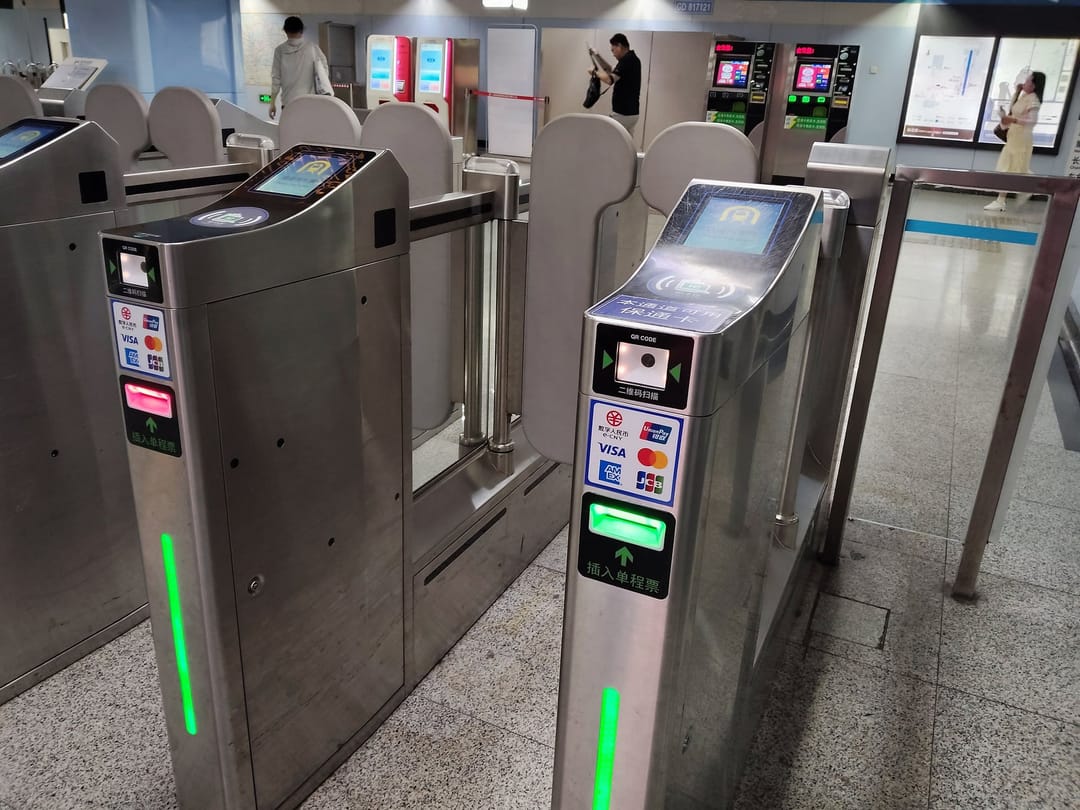
Can you pay with a Visa or Mastercard directly?
Where the logo is displayed, yes: hotels and other shops showing it, and the 2024 plan asks for more of them. You pay your bank’s foreign-currency fee, if your card has one, and no app fee.
The metro is one place where a card now works without an app. Beijing opened its gates to contactless Visa and Mastercard cards issued abroad on 13 September 2024, across 490 stations on 27 lines. Shanghai extended a trial of contactless bank cards to its whole network on 28 June 2025, for cards with small contactless payments enabled. Other cities have their own arrangements.
Transit codes in the apps are another route: Beijing’s metro accepts Alipay’s code linked to a foreign card, and Shanghai’s metro takes codes from Alipay, WeChat or its own Metro Daduhui app. For trains between cities, 12306 accepts Visa, Mastercard, JCB and Diners Club cards as well as Alipay and WeChat Pay, as the guide to China train tickets explains.
What about Apple Pay and PayPal?
Two newer routes appeared in 2026, both through Tencent’s payment network, and one older one serves visitors from parts of Asia.
TenPayGo, with Apple Pay
TenPayGo is a payment app that Tencent launched for visitors on 24 September 2026. It opens with an email address, without a Chinese number or a WeChat account, and it can be funded with Apple Pay, a foreign card on seven networks including Visa and Mastercard, or some foreign wallets; it then pays wherever WeChat Pay is accepted, Xinhua reported. Tencent has not published its fees or limits. Apple Pay presented directly at a Chinese terminal with a foreign card remains undocumented, so TenPayGo is the way to use it.
PayPal, for US accounts
Since 11 August 2026, US PayPal users can pay at WeChat Pay merchants from the PayPal app, by scanning the merchant’s code or showing their own, from their PayPal balance, PayPal announced. Other countries are to follow in phases, with no date given for the United Kingdom, Europe or Australia.
Home wallets through Alipay+
Visitors from several Asian countries can pay with the wallet they use at home, through Alipay’s cross-border network: AlipayHK, Touch ‘n Go, Kakao Pay, Naver Pay, Toss Pay, TrueMoney, Changi Pay and OCBC Digital are among the partners Ant Group listed in 2024. The payment is converted into yuan, and the wallet’s own rules apply.
When a payment does not go through
Most failures have a simple next step, and each one follows from the rules above.
- The app declines your card: link the same card in the other app, or a card on another network; otherwise pay cash.
- The app asks for verification: have your passport at hand. Alipay asks once a foreign user passes its unpublished quota, and WeChat asks for a copy when you verify with one.
- The amount is over the app’s limit: WeChat Pay stops at 6,500 yuan per payment with a foreign card, so a larger bill goes on a card at the terminal or in cash.
- There is no data on your phone: cash works without a network.
- The SMS code never arrives: check your home carrier’s spam filter before blaming the app.
- Your phone dies: cash and a card at the terminal do not need it, which is the reason to carry both.
What needs a phone connection?
Both apps need mobile data when you pay, to show your code or confirm a scan. A Chinese number is not required: WeChat accepts a foreign one that receives SMS, and a data eSIM keeps both apps online without one. Alipay and WeChat Pay are Chinese services and work on Chinese networks without a VPN.
Getting VAT back when you leave
Visitors staying in China for 183 days or less can claim back part of the VAT on goods bought in shops showing the tax refund sign. Since April 2025 the minimum is 200 yuan spent in the same shop on the same day, cash refunds go up to 20,000 yuan, and more shops pay the refund on the spot instead of at the airport, the government announced. Keep the receipt and the refund form, and show your passport.
Before you leave
- Install Alipay and WeChat, register with your usual number and add your card. What the trip will cost overall is in China trip cost.
- Read your card’s price list for payments in a foreign currency, and bring a second card on another network if you have one.
- Check the visa-free entry rules, then plan to withdraw some cash on arrival from an ATM showing your card’s logo.
Frequently asked questions
Do I need Alipay in China? An app is the simplest way to pay: Alipay or WeChat Pay with your own card. Cash and, where the logo is shown, a foreign card also work.
Do I need both WeChat and Alipay in China? One is enough for most payments. The second costs nothing to install and covers the case where the first declines your card.
How do you set up Alipay as a foreigner? Register with your phone number, choose English or another of its 16 languages, link a Visa or Mastercard, and verify with your passport when the app asks.
How do you pay in China with WeChat? Add your card under Me, Pay and Services, Wallet, then scan the merchant’s code or show your own payment code at the till.
Do I need a Chinese number for Alipay? No Chinese number is reported to be required. WeChat states it explicitly for its own app, as long as your number receives SMS codes.
Do I need a VPN to use Alipay in China? No. Alipay and WeChat are Chinese services and work on Chinese mobile networks and wifi without one.
Can you use cash in China? Yes. Yuan banknotes are legal tender and the central bank forbids refusing them, except for businesses that operate entirely online.
Can I pay in China with Revolut? A Revolut card is a Visa or Mastercard, so it can be linked to either app like any other. Revolut’s exchange fees and monthly limits then apply on top of the app’s.
How can you pay in China without a transaction fee? Keep each app payment at 200 yuan or less, use WeChat Pay’s 90-day waiver for new users until 31 December 2026, pay cash, or present a card without a foreign-currency fee directly at the terminal.
Can you use Apple Pay in China? Not at the till with a foreign card. The workaround is TenPayGo: sign up with an email, add Apple Pay as the funding source, and scan WeChat Pay codes.
Can you use PayPal in China? Only from a US account, by scanning a WeChat Pay code inside the PayPal app. British, European and Australian accounts are still waiting.
What are the limits on Alipay and WeChat Pay? WeChat Pay allows 6,500 yuan per payment with a foreign card, 50,000 a month and 65,000 a year. Alipay publishes none; Wise reports 3,000, 50,000 and 60,000.