Destinations · Beijing and the north
Things to do in Beijing, with what to book and where to stay
Beijing in three to five days: the sights and what to book with your passport, the Great Wall, day trips, where to stay and eat, and what to avoid.
thechinaatlas.com/en/beijing
In this article
Three days cover the heart of Beijing: the Forbidden City and the central axis, the Temple of Heaven, the hutongs, and a day on the Great Wall. Five let you add the Summer Palace, the Ming Tombs or a trip out of the city. The harder part is the order of things. Several of the main sights only let you in with a booking made days ahead under your passport, and the Forbidden City sells nothing on the day. Book those first, then fit the rest around them.
Central Beijing and the Summer Palace
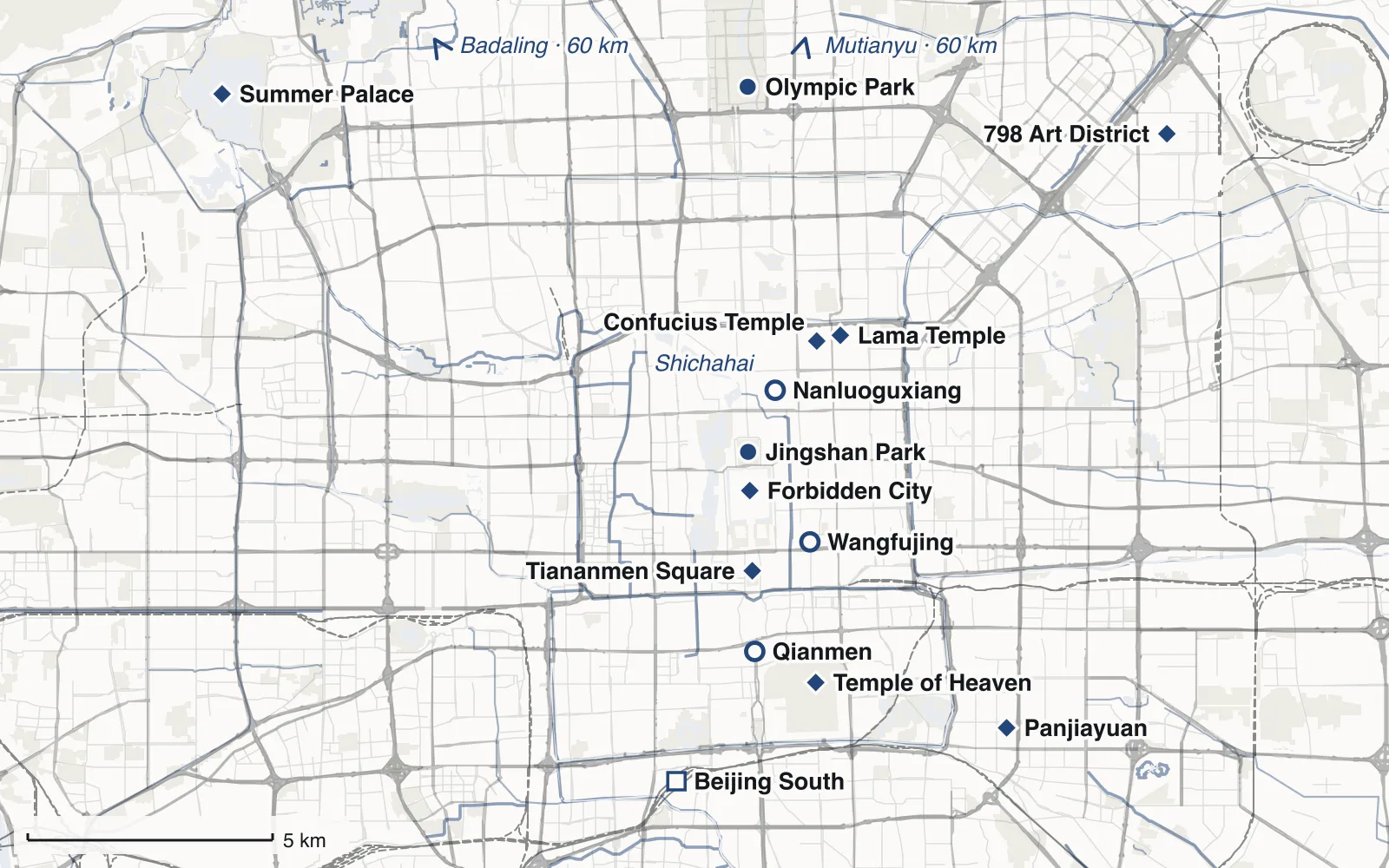
- Garden or park
- Sight
- Old street
- Station
Map: The China Atlas · Data: © OpenStreetMap contributors, © OpenMapTiles, OpenFreeMap
How many days do you need in Beijing?
Three full days are enough for a first visit, five for a slower pace and a day trip. A split that works: the central axis on day one (Tiananmen Square, the Forbidden City, Jingshan Park), the Temple of Heaven and the hutongs on day two, the Great Wall on day three. The Summer Palace, the Lama Temple and the 798 Art District fill a fourth day, the Ming Tombs or Tianjin a fifth. How Beijing fits into a ten-day, two-week or three-week trip is set out in the China itinerary guide.
Two things shape the plan more than distances do. The Forbidden City, the National Museum and the Confucius Temple close on Mondays outside public holidays, which makes Monday a good day for the Wall. And the busiest weeks of the year, the Spring Festival, 1 to 5 May and 1 to 7 October, fill every booking calendar at once. The dates and the weather month by month are in the guide to the best time to visit China.
What to book before you go
Beijing’s sights fall into two groups: those that need a booking under your passport, and those that sell tickets at the gate. The table gives both, with the high-season price (April to October) and the low-season price (November to March).
| Sight | Booking | How far ahead | Price | Closed |
|---|---|---|---|---|
| Forbidden City | Required, passport | 7 days, from 20:00 | 60 / 40 yuan | Mondays |
| Tiananmen Square | Required, passport | 1 to 7 days | Free | |
| Mao Memorial Hall | Required | 1 to 6 days | Free | Mondays, afternoons |
| National Museum | Required | Up to 7 days, from 17:00 | Free | Mondays |
| Badaling (Great Wall) | Required, passport | Up to 7 days | 40 / 35 yuan | |
| Mutianyu (Great Wall) | Required, passport | Up to 30 days | 40 yuan | |
| Temple of Heaven | Optional | 15 / 10 yuan, 34 / 28 combined | Halls on Mondays | |
| Summer Palace | Optional | 1 to 7 days | 30 / 20 yuan, 60 / 50 combined | Inner sites on Mondays |
| Lama Temple | Not needed | 25 yuan | ||
| Confucius Temple | Not needed | 30 yuan | Mondays | |
| Jingshan Park | Not needed | 2 yuan | ||
| Ming Tombs (Dingling) | Not needed | 60 / 40 yuan |
Updated:
Monday closures do not apply on public holidays. Prices and rules as published by each site and by Beijing’s tourism office, checked on 8 October 2026.
Book in the order the calendars open: Mutianyu up to 30 days ahead, then the Forbidden City, Badaling, Tiananmen Square and the National Museum within the last week. Each booking is tied to the passport number you enter, and you show the same passport at the gate, so type it exactly as printed.
The Forbidden City and the central axis
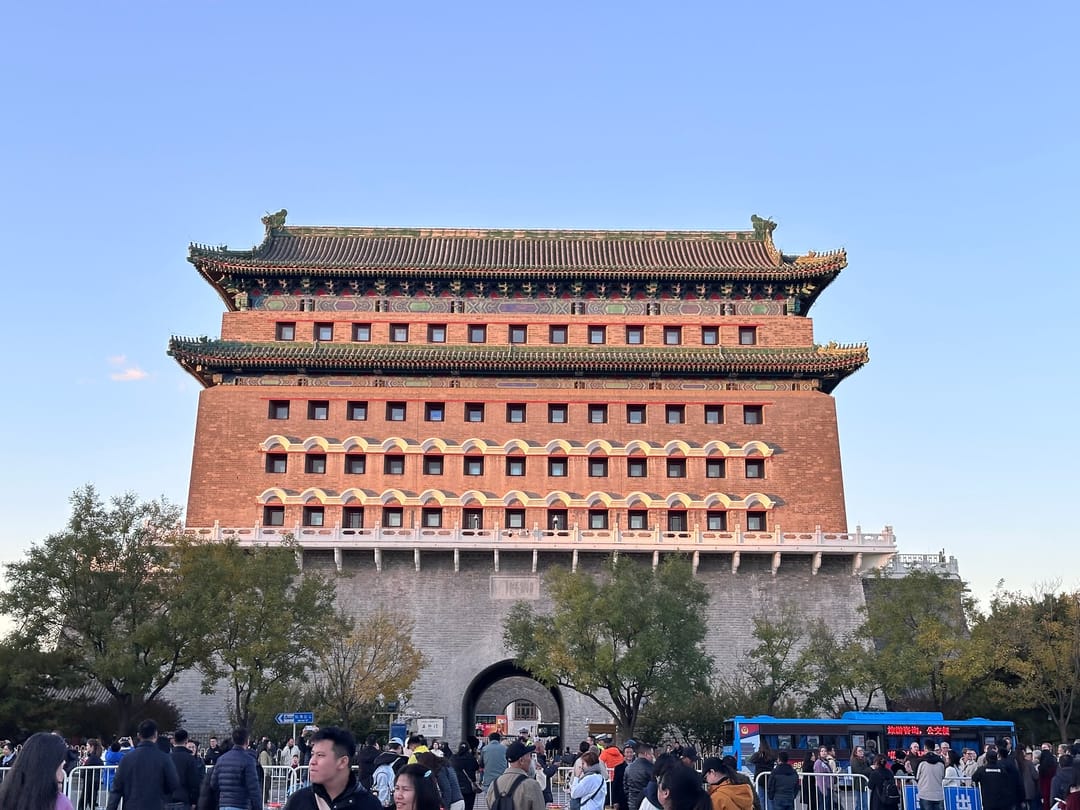
Tiananmen Square, the Forbidden City and Jingshan Park sit one after the other on the city’s north-south axis. Walked in that order, they take most of a day.
Forbidden City
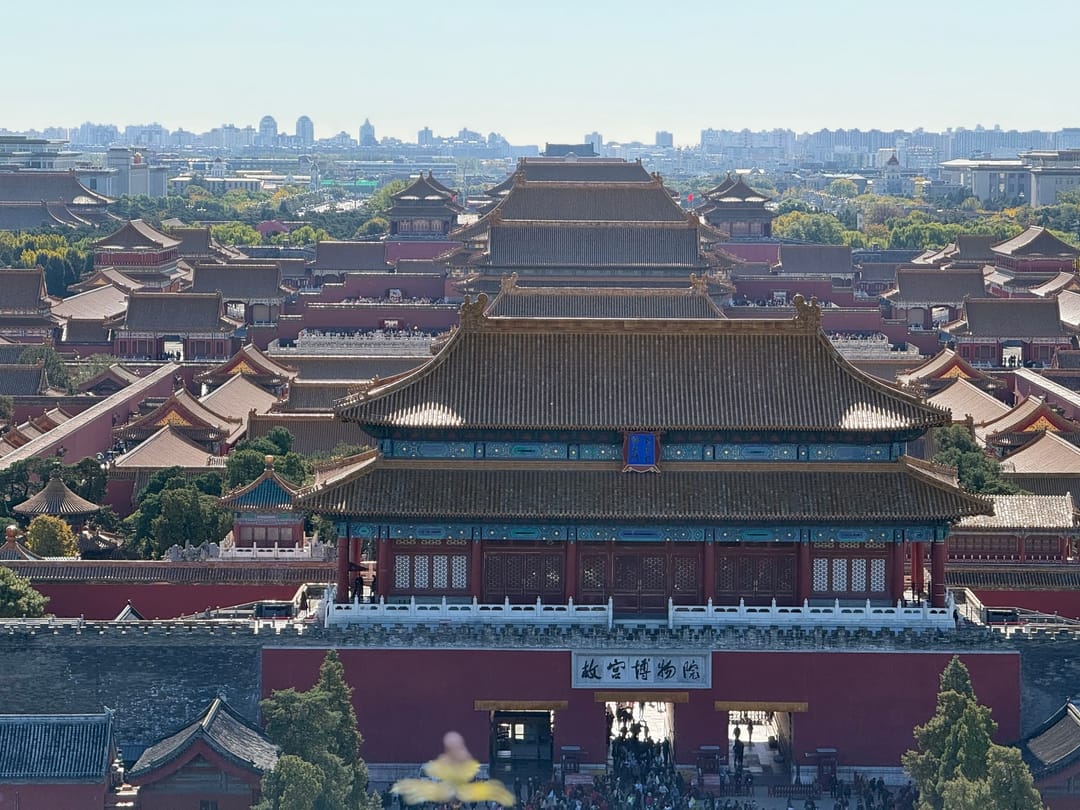
The Palace Museum, as the Forbidden City is officially called, costs 60 yuan from April to October and 40 yuan from November to March, plus 10 yuan each for the Treasure Gallery and the Clock and Watch Gallery, according to the museum’s visitor page. Tickets go on sale at 20:00 seven days before the visit, on the official ticketing site or the museum’s WeChat mini-program, under the name and number of your passport: one ticket per passport per day, and none sold on the day itself. The international version of the site works in English, with an account opened by email. Entries are capped at 40,000 a day.
Bring the original passport you booked with: the museum’s rules ask for the original document, and foreign visitors go through the manual ticket check at the Meridian Gate. The visit runs one way, entering only by that south gate and leaving by the Shenwu Gate to the north or the Donghua Gate to the east. From April to October the museum opens from 8:30 to 17:00, last entry 16:00; from November to March it closes at 16:30, last entry 15:30. It closes on Mondays except public holidays, and on Chinese New Year’s Eve. Half a day is a realistic minimum for the central halls and one of the galleries.
Tiananmen Square
The square is free, but entry needs a booking made one to seven days ahead, under the real name and ID of each visitor, with no same-day bookings, according to the notice of the square’s management committee of 24 September 2026. Foreign visitors book with their passport, through the square’s booking mini-program on WeChat, the Jingtong app or the booking website, then show the QR code and the passport at the security check.
On the south side, the Chairman Mao Memorial Hall reopened on 1 September 2026 after a renovation that began in March. It opens Tuesday to Sunday from 8:00 to 12:00, entry is free with a booking made one to six days ahead, and bags, cameras and liquids are not allowed inside. The National Museum of China, on the east side, is free too, with bookings opening seven days ahead at 17:00 on its ticketing site. It closes on Mondays except public holidays.
Jingshan Park
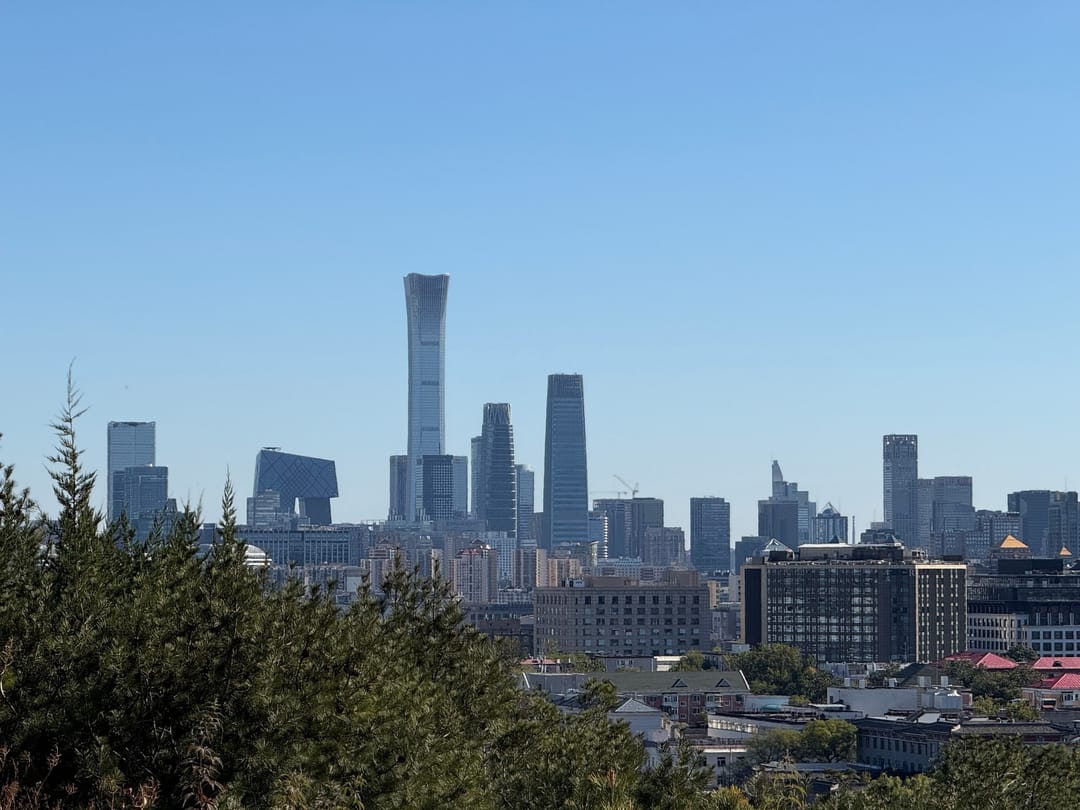
Jingshan is the hill just north of the Forbidden City: leaving by the Shenwu Gate puts you across the road from its south entrance. It costs 2 yuan, or 10 during the spring peony festival, and needs no booking, according to Beijing’s tourism office. The pavilion on the summit looks straight down the axis over the palace roofs, and east to the towers of the business district. The park opens from 6:00 to 21:00 between April and October and from 6:30 to 20:00 in winter, so it also works at the end of the day, after the museum has closed. Beihai Park, just to the west, has a lake and a white stupa for 10 yuan in high season and 5 in winter.
Temples and imperial gardens
Beijing’s other great sights sell tickets at the gate, which makes them easy to fit around the bookings above.
Temple of Heaven
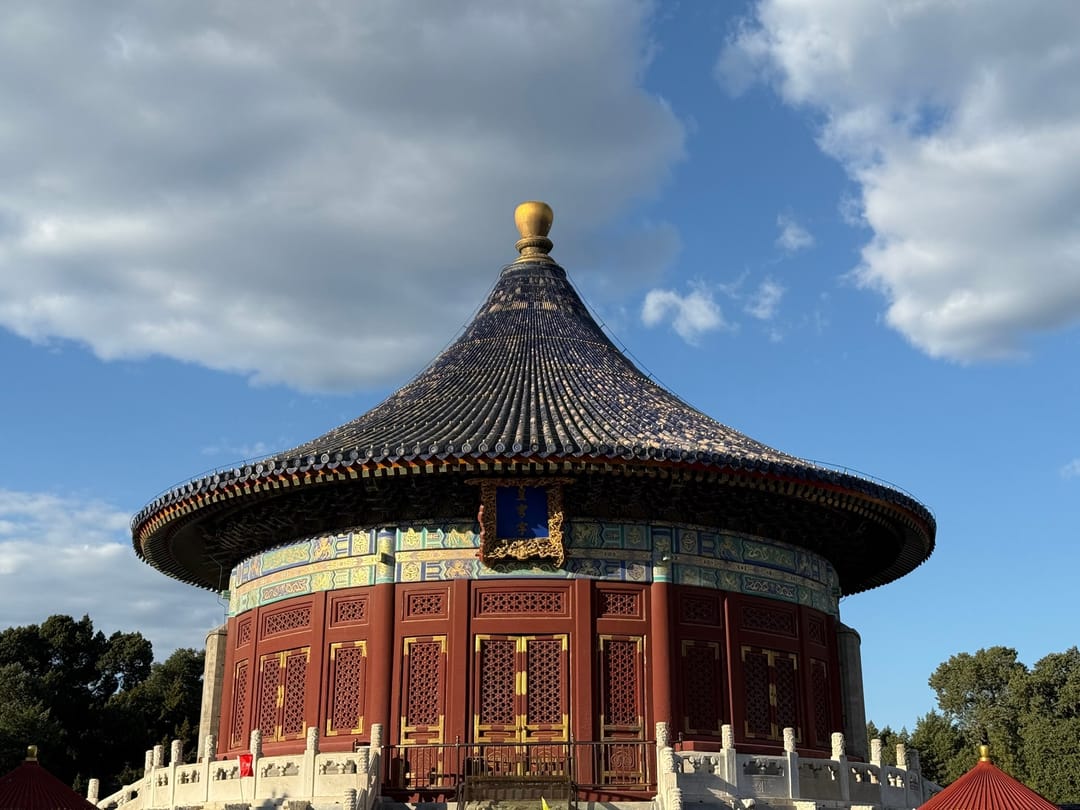
The Temple of Heaven costs 15 yuan for the park in high season and 10 in low season, or 34 and 28 yuan for the combined ticket that includes the Hall of Prayer for Good Harvests, the Echo Wall and the Circular Mound Altar, according to Beijing’s tourism office. Booking ahead has been optional since June 2024; foreign visitors show a passport at the gate. At the Hall of Prayer, you look into the interior through its open doors. The park opens at 6:00, or 6:30 in winter, long before the halls, and its early mornings are known for the residents who come to exercise and dance under the old cypresses. The halls close on Mondays, except on public holidays and in summer. Tiantandongmen station, on line 5, is at the east gate.
Summer Palace
The Summer Palace, in the north-west of the city, is a lake and a hill laid out as an imperial garden, with a long painted corridor along the shore. Entry costs 30 yuan in high season and 20 in low season, and the combined ticket, 60 and 50 yuan, also covers the areas ticketed separately, such as the Tower of Buddhist Incense and Suzhou Street, according to Beijing’s tourism office. Those inner areas close on Mondays. Booking is optional, one to seven days ahead on the palace’s ticketing site. Line 4 serves two gates, Xiyuan station the East Palace Gate and Beigongmen the North Palace Gate, so you can enter by one and leave by the other. Allow half a day.
Lama Temple
The Lama Temple, Yonghegong, is a working Tibetan Buddhist temple in the north-east of the old city. Its last hall holds a Maitreya Buddha carved from a single trunk of white sandalwood, 18 metres above ground, which Guinness World Records lists as the tallest statue carved from one piece of wood. Tickets cost 25 yuan, at the gate or through its WeChat account with a passport, and it opens every day, from 9:00 to 17:00 between April and October and until 16:30 in winter. Yonghegong station, on metro lines 2 and 5, is at its gate.
Confucius Temple and Imperial Academy
Across the lane from the Lama Temple, the Confucius Temple and the Guozijian, the imperial college of the Yuan, Ming and Qing dynasties, share a ticket of 30 yuan. They open from 9:00 to 17:00, last entry 16:30, and close on Mondays except public holidays, according to the city government’s ticketing page. Tickets are sold at the office or through the museum’s WeChat account. After the incense and crowds of the Lama Temple, the courtyards of steles and old cypresses are usually quiet.
The Great Wall from Beijing
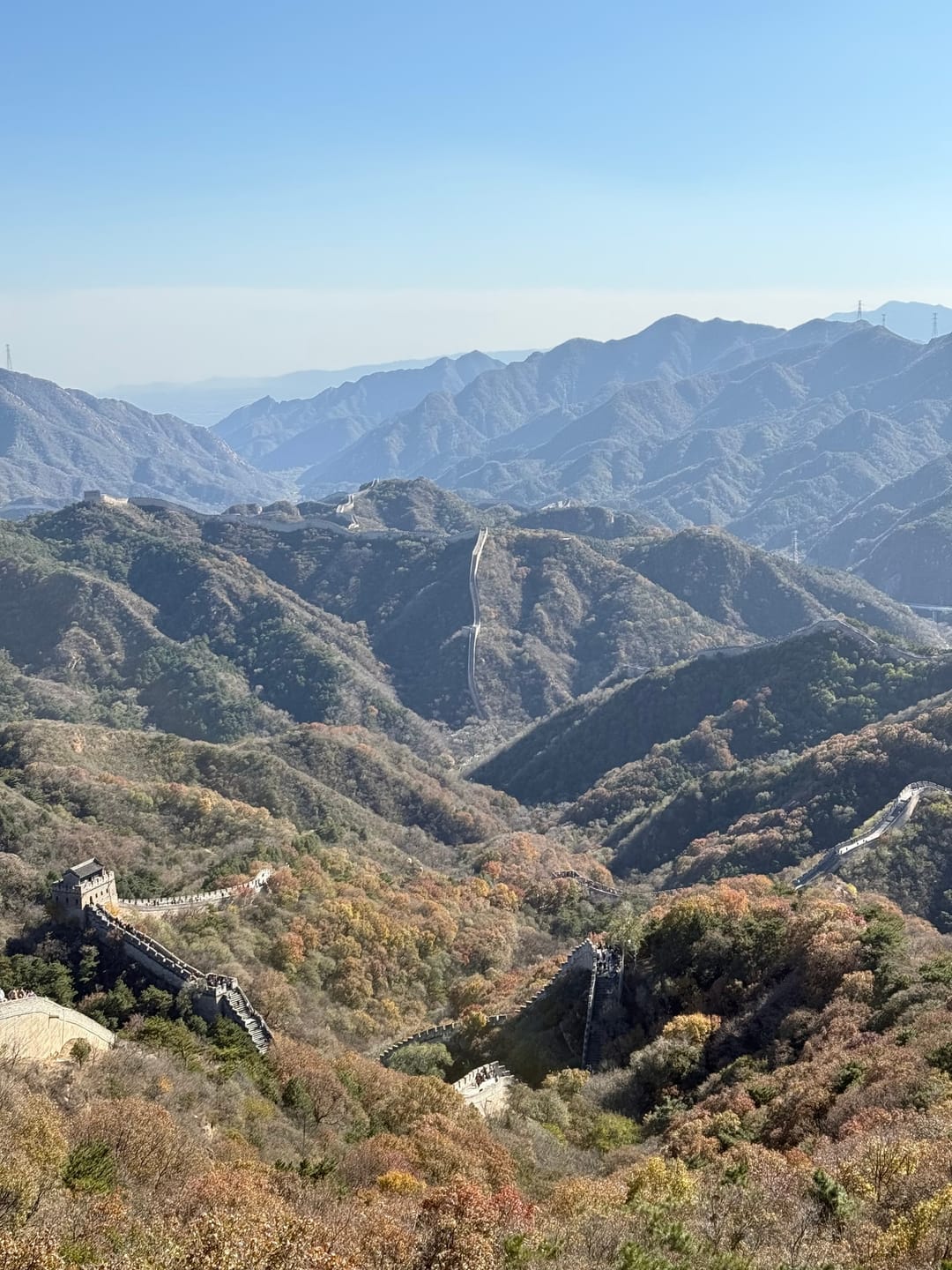
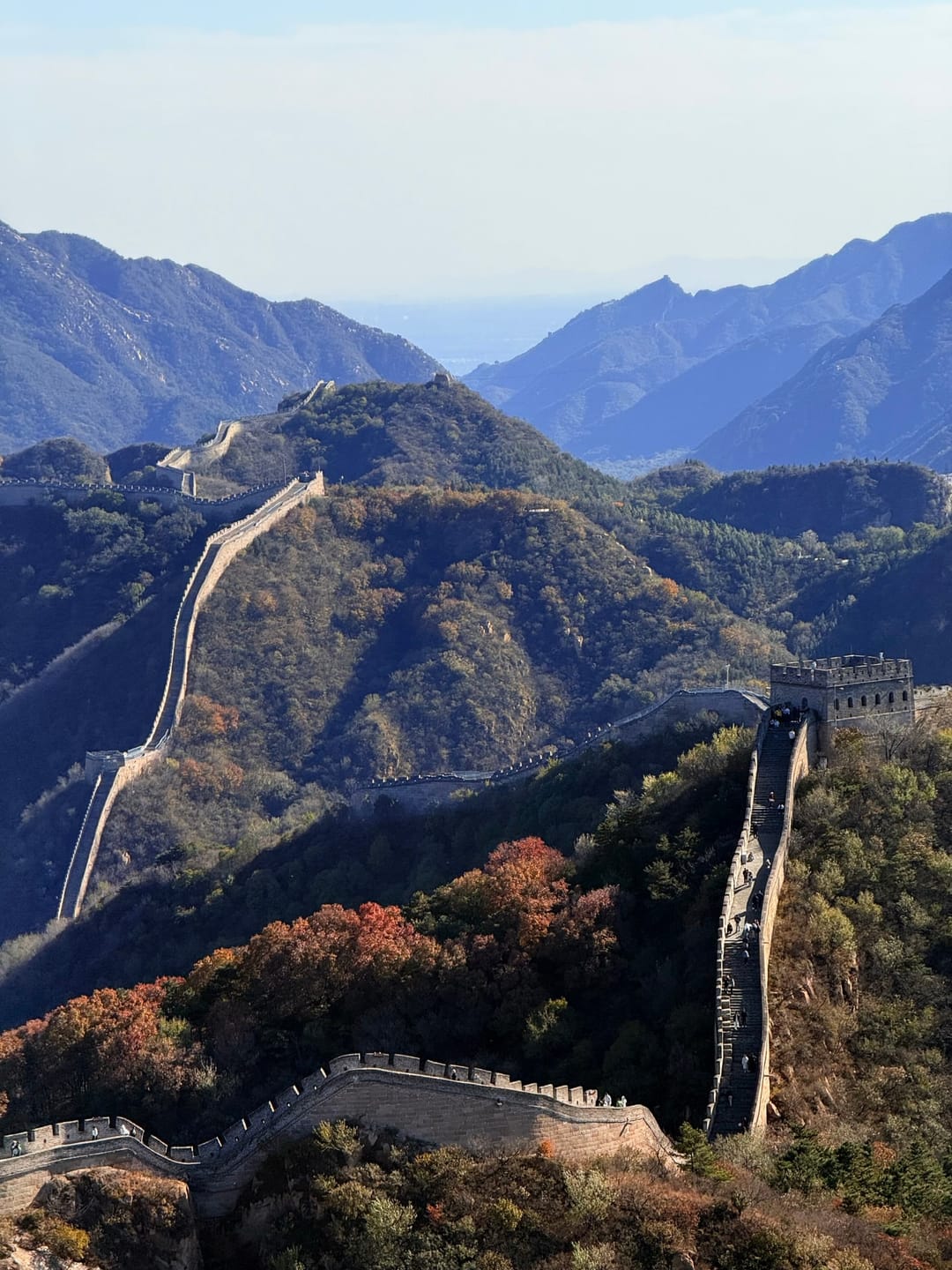
Four sections of the Wall are within reach of Beijing without a tour, all compared in the Great Wall guide: Badaling by high-speed train, Mutianyu by bus or car, and Jinshanling and Simatai, further out, by shuttle bus or car. Badaling and Mutianyu sell tickets under your passport.
Badaling
Badaling is the closest section to the city and the busiest. Entry costs 40 yuan in high season and 35 in low season, according to Beijing’s tourism office, and has required a real-name booking since 1 June 2019, up to seven days ahead. The daily reference capacity set then is 65,000 visitors; on May Day 2025 more than 100,000 came in a single day, according to the Ministry of Culture and Tourism.
The simplest way there is the high-speed line to Zhangjiakou. Trains from Qinghe station take 19 minutes to Badaling Great Wall station, and those from Beijing North 27 to 37, though not every train stops there: check the times back to the city when you arrive, before you climb. The tickets are sold on 12306 like any other train, as explained in the guide to China train tickets. Cable cars climb both sides of the pass, at 100 yuan one way and 140 return.
Mutianyu
Mutianyu, further north-east, has its own booking calendar, which opens 30 days ahead on the official site, with one ticket per passport per day. Entry costs 40 yuan, and a shuttle bus at 15 yuan return links the entrance area to the lifts. Two companies run those: one the cable car, the other the chairlift and the toboggan. Each costs 100 yuan one way and 140 return, and a ticket for one does not work on the other.
Without a car, bus 916 from Dongzhimen runs to Huairou Beidajie, where buses H23, H24, H35 and H36 continue to Mutianyu, about two hours in all. On holidays and some weekends, a tourist bus leaves the Wangjing West hub at 9:45 and returns at 15:30, for 80 yuan return, if at least 15 people have booked.
Jinshanling
Jinshanling, across the border in Hebei, is a long, partly restored stretch of wall along the ridges, further from the city than Badaling or Mutianyu. Entry costs 65 yuan in high season and 55 in low season. Its cable car stops in winter and runs in season, at 40 yuan one way and 60 return, according to the Chengde press.
Simatai and Gubei Water Town
Simatai costs 40 yuan by day, booked at least a day ahead. Its night visits, from May to October with entry until 21:30, cost 200 yuan with the return cable car on the booking system of Gubei Water Town, the rebuilt old town at its foot, run by the same operator. A shuttle bus from Dongzhimen takes about two hours, which makes Simatai and Gubei an overnight trip rather than a day out.
Beyond the imperial city
Beijing also has a modern side worth a half-day, and an evening stage that is older than most of its museums.
798 Art District
The 798 Art District, a former factory complex in Chaoyang, is free to walk around, with galleries, cafés and some paid exhibitions. Its anchor, the UCCA Center for Contemporary Art, opens Tuesday to Sunday from 10:00 to 19:00 and closes on Mondays, according to its visitor page, so avoid Mondays. Gaojiayuan station on line 12, opened in December 2024, is about 200 metres away; Jiangtai on line 14 also works.
Olympic Park
The Olympic Park, in the north of the city, keeps the 2008 venues: the National Stadium, known as the Bird’s Nest, and the National Aquatics Center, the Water Cube. The Bird’s Nest opens to visitors from 10:00 to 22:00, last entry 21:00, except on event days. Its ticket prices vary from one source to another, so check at the gate. It is at its best after dark, when the stadium is lit.
Universal Beijing Resort
Universal Beijing Resort, in Tongzhou to the east, has its own station, Universal Resort, on line 7 and the Batong line. Its tickets are dated, with a price that changes by day on the resort’s calendar, so book the day you want rather than an open ticket.
Peking opera
The Huguang Guild Hall, built in 1807, has run a resident Peking opera show since December 2024, China Daily reported. The Liyuan Theatre, inside the Qianmen Jianguo Hotel, has staged performances aimed at visitors since 1990. Both sell through ticketing apps; check the current programme before you go, as schedules change with the season.
Day trips from Beijing
Ming Tombs
The Ming Tombs, north of the city, are the burial ground of thirteen Ming emperors. Three are open to visitors: Dingling, whose underground palace can be entered, costs 60 yuan in high season and 40 in low season; Changling, the largest, 45 and 30; Zhaoling 30 and 20, according to the city government. No booking is required. Bus 872 runs directly from Deshengmen. Low-season prices start on 1 November.
Tianjin
Tianjin, a port city with a historic quarter of European buildings and a riverside, is 30 minutes from Beijing South on the fastest high-speed trains. Tickets are booked on 12306 as for any train, and the short journey makes it an easy day out.
Chengde
Chengde, in Hebei, has the Mountain Resort, the summer palace of the Qing emperors, and a ring of temples around it. Since 1 July 2025 the fastest trains take 49 minutes from Beijing Chaoyang to Chengde South. The Mountain Resort costs 130 yuan from April to October and 90 yuan from November to March.
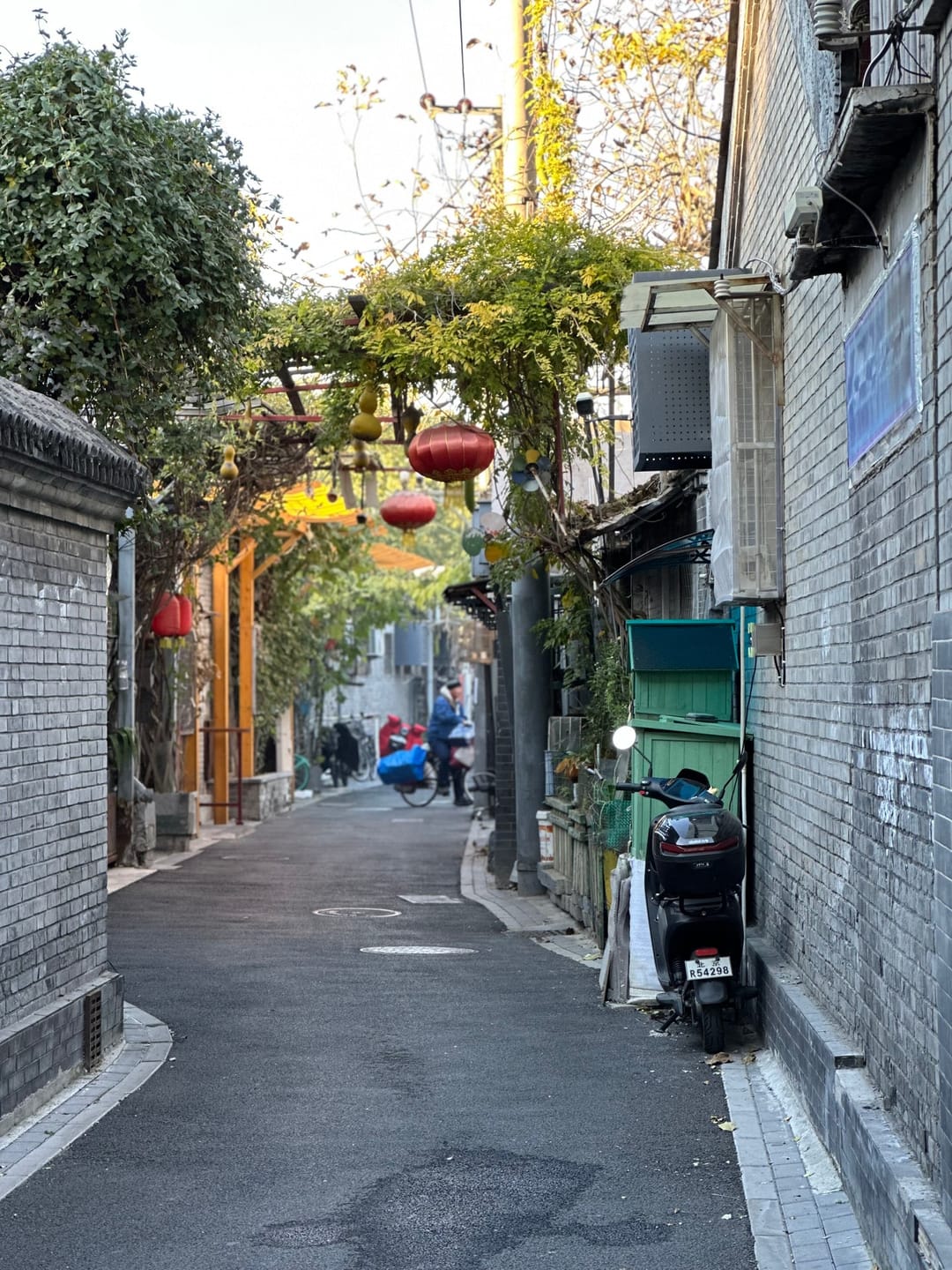
Hutongs and the lakes
The hutongs, lanes of single-storey courtyard houses that once made up most of the old city, survive in patches around Shichahai, the Drum Tower and Dongsi. None charges entry or needs a booking.
Shichahai
Shichahai is the chain of three lakes north of Beihai: Qianhai, Houhai and Xihai. Bars and restaurants line the banks, and the lanes behind lead to the Drum and Bell Towers by way of Yandai Xiejie, a short slanting street of craft shops and cafés. It is at its best late in the afternoon and in the evening, and it pairs naturally with Jingshan and Beihai, a short walk away.
Nanluoguxiang
Nanluoguxiang, east of the lakes, is the best-known lane and the most crowded, lined with shops and snack stalls. It stopped accepting tour groups on 25 April 2016 and gave up its scenic-area rating at the same time, and cars are banned from it between 9:00 and 22:00. The side lanes running off it to the east and west are quieter and closer to what a hutong looks like when nobody is selling anything.
Dongsi
Dongsi, east of the Forbidden City, has a grid of parallel lanes numbered from Dongsi Toutiao to Dongsi Shisitiao, still mostly residential. It is the better place to see how the hutongs are lived in, as long as you remember that the doors open onto people’s homes. To see a courtyard house from the inside, the Shijia Hutong Museum, a little to the south, is free, opens Tuesday to Sunday from 9:30 to 16:30 and needs no booking for individual visitors.
Where to stay in Beijing
Any licensed hotel can take you. In May 2024 the Ministry of Public Security, the Ministry of Commerce and the immigration administration told hotels they may not turn away foreign guests by claiming to lack a licence for them, China Daily reported. The hotel registers you with the police at check-in. In a private flat or rental, you or your host must register within 24 hours of arrival, which can be done online across the country since 21 September 2026, on the website or the 12367 app of the immigration administration or its WeChat and Alipay mini-programs. The guide to where to stay in Beijing compares the areas, with the metro to each sight, hotels and December prices.
Wangfujing and Dongcheng
Wangfujing, east of the Forbidden City, is the default base for a first visit: its pedestrian street runs for 810 metres with more than 700 shops, and its line 1 station is one stop from Tiananmen East. The surrounding Dongcheng district holds most of the sights in this guide, from the palace to the Lama Temple.
Dongsi and the hutongs
Small hotels in converted courtyard houses are scattered through the lanes of Dongsi, Nanluoguxiang and Shichahai, and put you inside the old city. Expect small rooms, and check how far the nearest street and metro station are before you book: many lanes are too narrow for a taxi to reach the door. Dongsi station, on lines 5 and 6, serves the eastern lanes.
Qianmen
Qianmen and Dashilar, south of Tiananmen Square, mix Qing-era shopfronts with boutique hotels. If you land at Daxing, whose express ends at Caoqiao in the south, it is the closer side of the centre; from Capital Airport, the north-east, around Dongzhimen and Beixinqiao on the Capital Airport Express, is the quicker base.
Sanlitun
Sanlitun, in Chaoyang east of the old city, is the district of bars, restaurants and the Taikoo Li shopping centre, next to the embassy quarter. It is further from the imperial sights, and the right choice if evenings out matter more than early starts.
Eating in Beijing
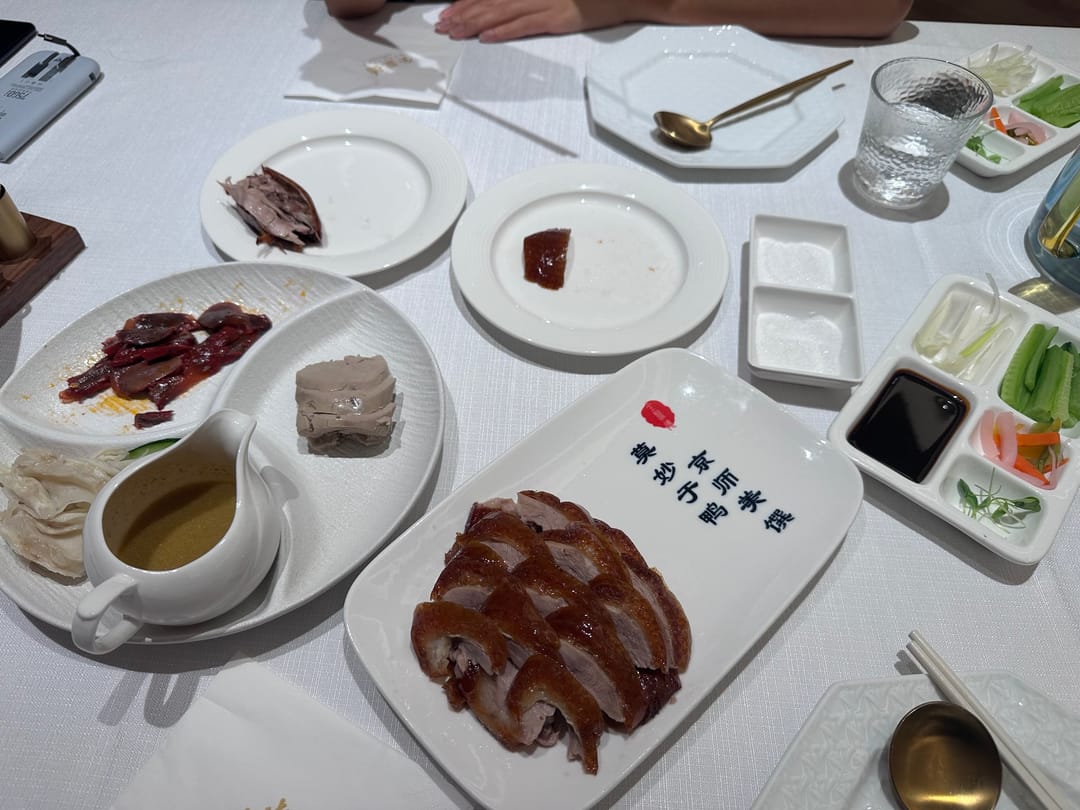
Peking duck
Peking duck is the dish the city is known for: roasted until the skin is crisp, carved at the table and eaten rolled in thin pancakes with scallion, cucumber and sweet bean sauce. Two methods divide the restaurants, and two old houses embody them: Quanjude, founded in 1864, roasts its ducks hanging over an open fire, while Bianyifang, which traces itself back to 1416, uses a closed oven, according to the city government’s page on time-honoured brands. For a modern version, the Nanxincang branch of Da Dong holds a star in the Michelin Guide Beijing 2026. The usual unit is a whole duck, so it is a dinner for several people; many restaurants also serve a half.
Hot pot, breakfast and late nights
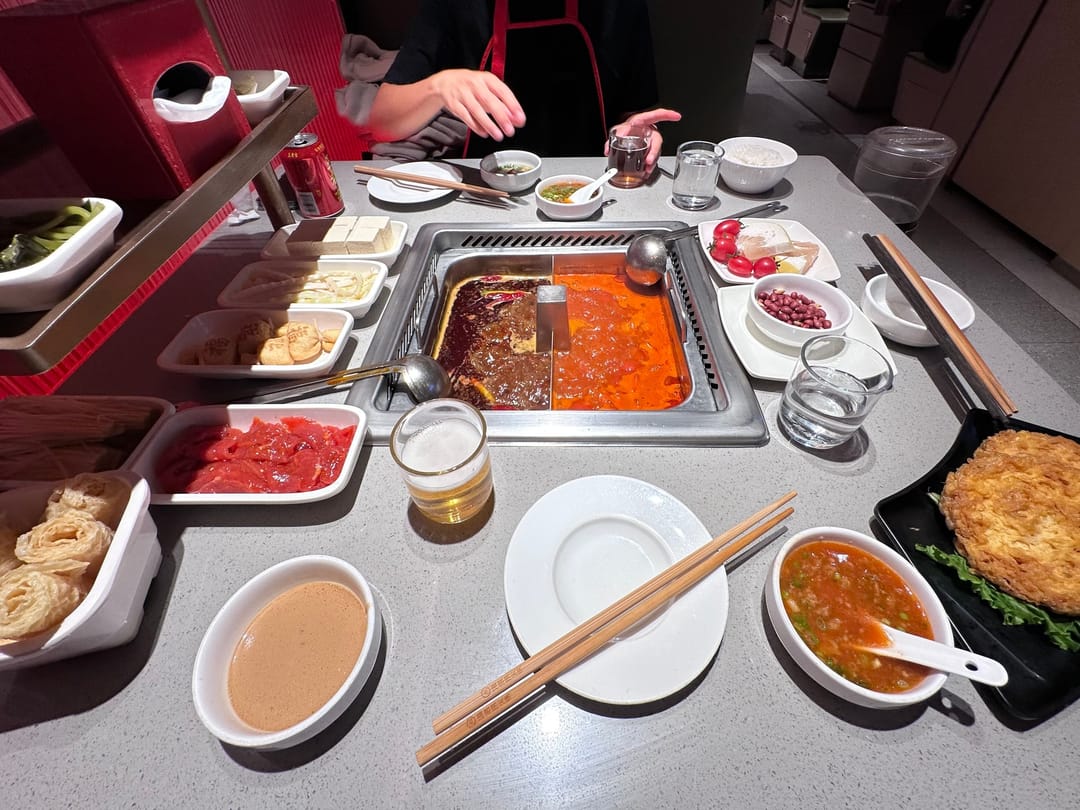
Donglaishun, founded in 1903, is the name for Beijing’s copper-pot mutton hot pot, thin slices of lamb dipped in plain broth and eaten with sesame sauce. The traditional breakfast is douzhi, a sour fermented mung-bean drink, with jiaoquan, crisp fried rings of dough: an acquired taste, and a very local one. For late meals, Guijie, Dongzhimen Inner Street, has some 150 restaurants along less than 1.5 km, many of them open through the night.
Noodles and street food
Zhajiangmian, wheat noodles under a thick fermented bean sauce with raw vegetables, is the everyday Beijing lunch. Jianbing, a thin crepe folded around egg, herbs and a crisp cracker, is breakfast from street stalls. Almost everything is paid by phone, and both Alipay and WeChat Pay take foreign cards, as explained in the guide to paying in China.
Shopping in Beijing
Qianmen and Dashilar
Dashilar, the lane west of Qianmen Street, is where Beijing’s time-honoured shops still trade: Ruifuxiang, a silk house founded in 1893 that supplied the silk for the first national flag in 1949; Neiliansheng, making cloth shoes by hand since 1853; and Tongrentang, the pharmacy founded in 1669. All three still trade there, and the lane is the place for silk, tea and traditional goods.
Wangfujing
Wangfujing is the city’s main shopping street, a pedestrian stretch of 810 metres with more than 700 shops, from department stores to bookshops and brand flagships, at Wangfujing station on line 1.
Wudaoying and Yandai Xiejie
Wudaoying Hutong, opposite the Lama Temple, is a 632-metre lane of independent designer shops, specialty coffee, pottery studios and small galleries, with the temple roofs in view. Yandai Xiejie, by the lakes, sells crafts and souvenirs in old shopfronts. Both are better for small gifts than the big malls.
Panjiayuan
Panjiayuan, at the station of the same name on line 10, is Beijing’s antiques and flea market: porcelain, calligraphy, old books and a great deal of reproduction. Its opening hours change with the season and the day of the week, so check them before going, and assume that anything sold as antique is a copy unless it comes with papers.
Getting around Beijing
From the airports
Beijing has two airports. From Capital (PEK), the Capital Airport Express costs 25 yuan and runs from Terminals 3 and 2 to Sanyuanqiao, Dongzhimen and Beixinqiao, roughly every ten minutes, according to the airport’s transport page; trains leave Dongzhimen for the airport from 6:00 to 22:30. From Daxing (PKX), the Daxing Airport Express takes about 20 minutes to Caoqiao, where it meets metro lines 10 and 19, for 35 yuan, or 50 in business class.
A metered taxi from Capital to the centre usually comes to 100 to 150 yuan plus a 10 yuan toll, and from Daxing to 150 to 250 yuan. There is no airport surcharge.
The metro
Since 13 September 2024, every gate on every line, both airport lines included, accepts a contactless Visa or Mastercard: you tap your own card, with no app and no passport, the city government announced. JCB and American Express followed in June 2025. Fares run from 3 yuan for up to 6 km to 6 yuan for 32 km, then one yuan more for each further 20 km.
Alipay’s transport code works too, once the app is set up with a foreign card, and ticket machines with an English menu sell single journeys. Every station has a security check, with bags passed through an X-ray machine.
Taxis and DiDi
Taxis run on the meter: 13 yuan for the first 3 km, then 2.30 yuan per km, with 20% added between 23:00 and 5:00 and tolls paid by the passenger. DiDi, the ride-hailing app, works in English with a foreign phone number and a foreign card, and its chat translates your messages to the driver; setting it up is covered in the DiDi guide. For either, having the address in Chinese characters saves a lot of explaining, and a working data connection matters for DiDi: the options are in the guide to choosing a China eSIM.
Trains to other cities
Beijing has seven large railway stations: Beijing, Beijing South, Beijing West, Beijing North, Beijing Chaoyang, Beijing Fengtai and Qinghe. Beijing South serves Shanghai, Tianjin and Qingdao, 3 h 07 away on the fastest train, Beijing West serves Xi’an, Beijing Chaoyang serves Chengde and the north-east, including Harbin, 4 h 33 away on the fastest train, and Qinghe and Beijing North serve Badaling and Datong, 1 h 45 away on the fastest train. The station is shown on your booking: read it twice, because the stations are far apart.
Mistakes to avoid
- Turning up at the Forbidden City without a booking: no tickets are sold on the day.
- Bringing a photo of your passport: the museums and the square ask for the original.
- Counting on Google Maps: Google’s services, Maps included, are blocked in mainland China, Freedom House notes. Amap has had an English version since January 2025, and German and Italian since July 2025.
- Planning the Forbidden City, the National Museum or the Confucius Temple on a Monday.
- Following a friendly stranger to a tea tasting: the UK government warns of tea-tasting and massage scams aimed at visitors, while noting that serious crime against foreign nationals is relatively rare, in its travel advice for China.
- Heading to the wrong railway station, or missing the last train back from Badaling.
- Bringing a drone: since 1 May 2026 drones may not be brought into Beijing, and from 15 November 2026 any flight is banned, with fines of up to 10,000 yuan, according to the city’s People’s Congress.
Itineraries
Three days
- Day one. Tiananmen Square and the Forbidden City, both booked, entering by the Meridian Gate; Jingshan Park on the way out; Shichahai in the evening.
- Day two. The Temple of Heaven in the morning; the Lama Temple, the Confucius Temple and the lanes of Dongsi in the afternoon.
- Day three. The Great Wall, at Badaling by train from Qinghe or at Mutianyu by bus, booked ahead.
Five days
Add two days to the plan above. On day four, the Summer Palace in the morning, then the 798 Art District in the afternoon, outside Mondays, and the Olympic Park after dark. On day five, a trip out: the Ming Tombs by bus 872, or Tianjin by high-speed train from Beijing South. If your trip starts with a flight into Beijing, check who can enter China without a visa and for how long before you book anything.
Frequently asked questions
How many days do you need in Beijing? Three for the main sights, including a day on the Great Wall; five with the Summer Palace and a day trip.
Do you need to book the Forbidden City in advance? Yes. Booking opens a week before your visit, at 20:00 Beijing time, with one ticket per passport per day; there is nothing to buy at the gate.
Is Tiananmen Square free? Yes. It still takes a reservation in your passport’s name, made at least a day and at most a week before.
Which part of the Great Wall is best from Beijing? For a first visit without a car, Badaling: the train from Qinghe gets there in under half an hour. With more time, Mutianyu, quieter and greener, with a toboggan for the way down.
Can you visit the Great Wall without a tour? Yes. Badaling has its own station on the Zhangjiakou high-speed line, and buses from Dongzhimen reach Mutianyu via Huairou in about two hours.
Where is the best area to stay in Beijing? Wangfujing and Dongcheng for a first visit, close to most sights; a courtyard hotel in the hutongs for atmosphere; Sanlitun for nightlife.
Is Beijing safe for foreigners? By the measure of official travel advice, yes: violent crime against visitors is uncommon. What catches people out are scams, the overpriced tea tasting above all.
How much money do you need per day in Beijing? Entry fees are modest: 60 yuan for the Forbidden City, 34 for the Temple of Heaven’s combined ticket, 40 for Badaling, and 3 to 6 yuan per metro ride. Meals and hotels make the difference.
Can you pay for the Beijing metro with a foreign card? Yes. Tap a contactless Visa, Mastercard, JCB or American Express card on the gate, as you would at home: the fare comes off the card, with no ticket and no app.
What is there to do in Beijing at night? Shichahai’s lakeside bars, Guijie’s late restaurants, the lit Bird’s Nest, Jingshan Park until 21:00 between April and October, and a Peking opera show.
What should you buy in Beijing? Silk, tea and cloth shoes from the old houses of Dashilar, and designer goods in Wudaoying; treat the antiques of Panjiayuan as reproductions.
When is the best time to visit Beijing? April, May, September and October, with daytime highs of 19 to 27°C, outside the 1 to 5 May and 1 to 7 October holidays.