Practical · Getting around
China train tickets: how to book and board as a foreigner
Booking China’s trains on 12306 or Trip.com with a passport: when sales open, what seats cost, refund fees, luggage limits, and how the station works.
thechinaatlas.com/en/china-train-tickets
In this article
You can book a Chinese train with nothing more than a passport: on 12306, the national railway’s own site and app, or through an agent such as Trip.com. Tickets go on sale 15 days ahead, at a fixed hour that depends on the departure station, and your passport then works as the ticket, from the entrance gate to the exit at the other end. What takes planning is the identity check on 12306, the release time of your station, and the passport lane at the gate.
How do you book a train ticket in China?
There are three ways in, and they sell the same seats. The fare is set by China Railway; what changes is how much of the process you handle yourself.
12306, the official app
12306 is China Railway’s booking site and app, with an English version that accepts only foreign passports. You register with an email address, then pass an identity check before you can buy: accounts still waiting for it cannot purchase, according to the railway’s own rules. Since 28 November 2023 the check can be done online, either automatically or by uploading a photo of your passport page for a person to review, as the Chinese government announced. In October 2024 China Railway said manual reviews usually take 3 to 5 working days. Enter your name in the order it appears on the passport. Payment works with Visa, Mastercard, JCB and Diners Club cards and with Alipay or WeChat Pay; American Express is not listed. Once a seat is held, you have 30 minutes to pay before it is released, under a 12306 rule in place since 2015.
Trip.com and other agents
Agents book the same 12306 stock with your passport details and need no identity check on your side. On 8 October 2026 Trip.com showed the same fares as 12306, train by train, and its train page says «No booking fee». Its own refund guide, dated 26 May 2026, adds that a 15-yuan handling fee applies when a ticket has to be issued by hand. Travel China Guide advertises service fees from 6 dollars a ticket, China Highlights from 5 to 9. These are the vendors’ own terms, worth reading at checkout.
At a ticket window
Every large station has ticket windows, and a passport is accepted there. Write the train number, date, class and destination on your phone so the clerk can read them. The window also handles refunds and changes, and it is where a passport that a machine refuses gets dealt with.
When do tickets go on sale?
Fifteen days ahead, counting the day of travel, and at a specific minute of a specific hour.
The pre-sale window
The 15-day window has applied since February 2021, according to the 12306 announcement that set it, and the passenger rules in force since 1 June 2026 repeat it. Every platform must respect it, CCTV reported in February 2026; an agent that takes orders weeks ahead is collecting requests, filled when the window opens. On 8 October 2026, 12306 was selling trains up to 22 October and nothing beyond. One exception is being tested: since 20 July 2026, the 12306 app has let travellers file requests for more than 200 trains on the Beijing–Shanghai high-speed and conventional lines well ahead of the window, filled 20 to 16 days before departure, Xinhua reported. The request window, first 60 to 17 days before travel, becomes 30 to 17 days from 27 October 2026, according to Guangming Daily. A request is not a ticket, and whether foreign-passport accounts can use it, with its face check, is not stated.
The release time
Each station opens sales at its own time, which 12306 publishes in a release-time lookup. On 8 October 2026 it gave 12:45 for Beijing South, 08:00 for Beijing West, 13:45 for Shanghai Hongqiao, 14:45 for Shanghai’s main station, 10:15 for Guangzhou South, 10:30 for Xi’an North and 08:45 for Chengdu East. The page warns that stations may adjust these times, so check the one for your departure station.
Busy weeks and the waiting list
The pressure comes in the holiday weeks: around the Spring Festival, the 1 May holiday and the National Day week from 1 October, popular trains fill at release. When a train is full, 12306 offers a waiting list: you pay a deposit, and the system buys a seat automatically if one comes free, refunding the difference or the whole deposit. It is open only to accounts that have passed 12306’s check of the person against the ID; the English site does not offer it, so with a foreign passport the route is the Chinese-language app.
Which train, which seat?
The letter in front of the train number tells you the type of train, and the seat class decides the space you get.
G, D and the other letters
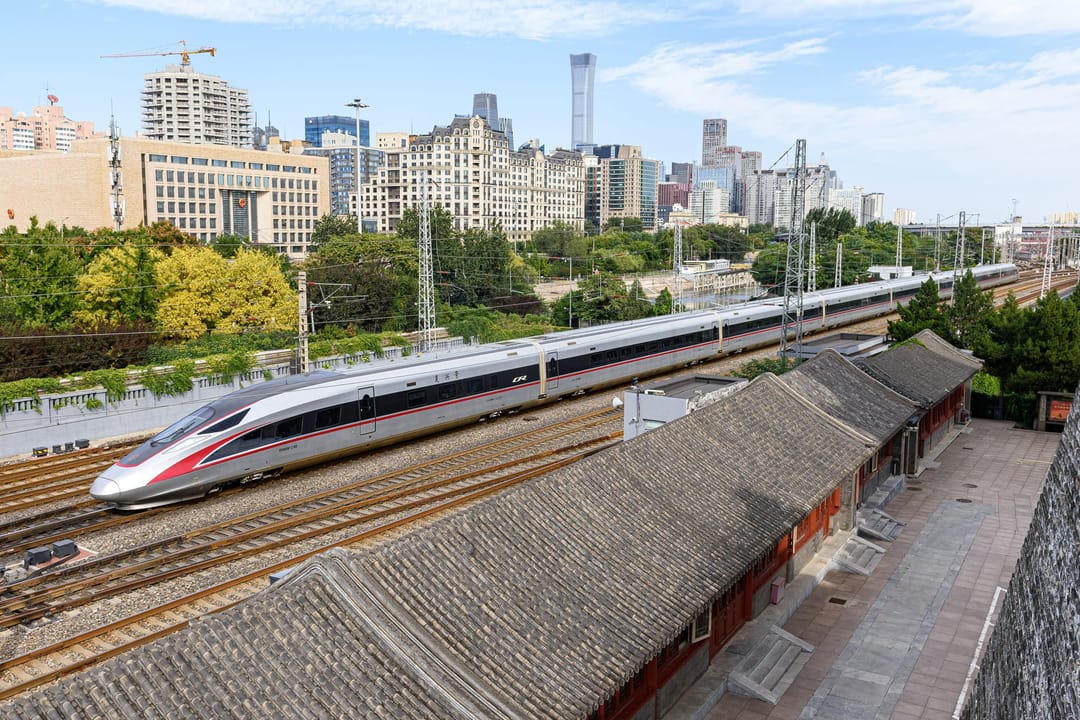
G trains are high-speed trains running at up to 350 km/h, D trains are slower electric multiple units, and C trains are intercity services, according to a CCTV explainer of October 2025. Z, T and K are conventional trains, from direct expresses down to fast trains with more stops. For most journeys between big cities, G trains are the default; the fastest Beijing to Shanghai service, G25, takes 4 hours 18 minutes on the timetable for October 2026. The high-speed network reached 50,000 km at the end of 2025, out of 165,000 km of railway, according to the National Railway Administration; the CR450, built for 400 km/h, was still in testing in October 2026.
Second, first and business class
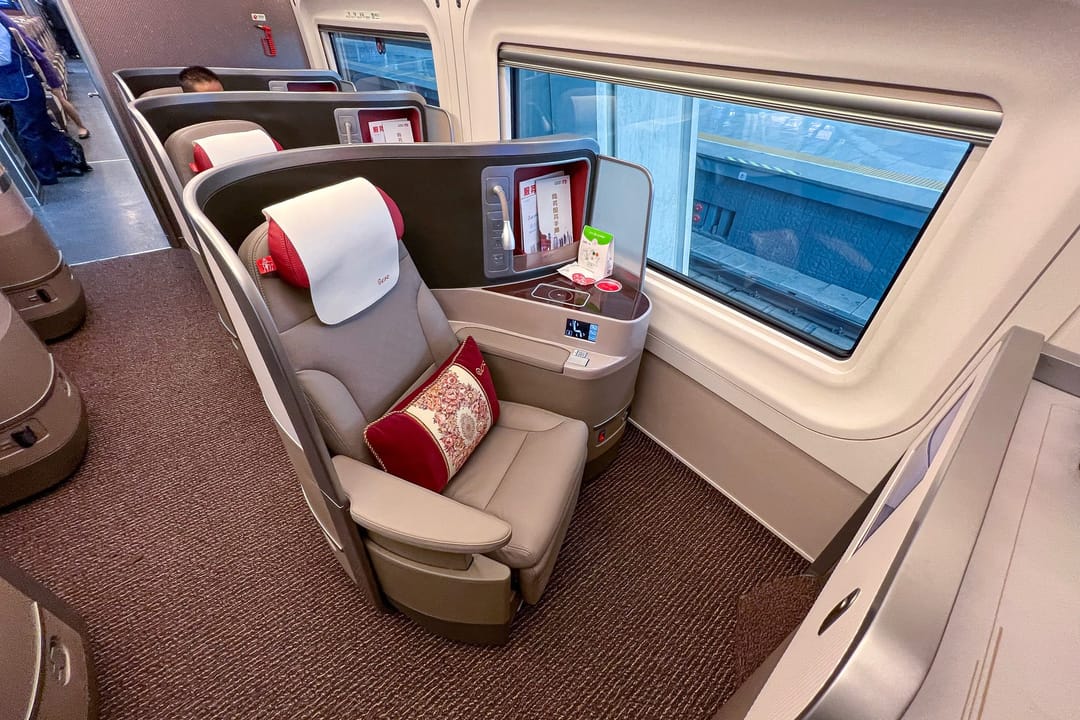
On a Fuxing CR400AF, second class has five seats across, first class four, business class three, according to the seat map 12306 publishes. Business-class passengers get a free meal at lunch and dinner time, and first-class passengers drinks and snacks on some trains, says the railway’s service page. A «premium first» class with seats that turn to face the window runs on upgraded Beijing–Shanghai trains, Xinhua reported in June 2024.
| Class | Seats per row | What you get |
|---|---|---|
| Second | 3 + 2 | the standard seat, quiet carriages on many trains |
| First | 2 + 2 | wider seat, drinks and snacks on some trains |
| Business | 1 + 2 | reclining shell, meal at mealtimes |
Updated:
Sleepers
Night trains still run, and some are high-speed. D trains with berths leave Beijing for Shanghai in the evening and take about 12 hours, and others link Beijing and Guangzhou in about 10 and a half, on 12306’s timetable for October 2026. On the D7, which leaves Beijing at 19:18 and reaches Shanghai at 07:25, a second-class berth cost 440 yuan and a first-class berth 601 yuan for mid-October travel, against 361 yuan for a second-class seat. Conventional sleepers come in soft berths (four to a closed compartment), hard berths (six, in open bays) and, on some trains, deluxe compartments for one or two with their own toilet.
Tickets without a seat
When seats run out, 12306 can sell standing tickets, marked 无座 (no seat), on some lines and at peak times. They cost the same as second class, because the system treats them as that class, China News Service reported in August 2026. For a short hop it can work; for four hours it is a long way to stand.
What does a ticket cost?
Fares vary by train, class and time of day on the busiest lines. The figures below come from 12306’s fare search, made on 8 October 2026 for travel on 20 October.
Fares on the main routes
| Route | Second class | First class | Business class |
|---|---|---|---|
| Beijing South → Shanghai Hongqiao | 553 to 661 yuan | 929 to 1,058 yuan | 1,744 to 2,315 yuan |
| Beijing West → Xi’an North | 494 to 618 yuan | 790 to 988 yuan | 1,621 to 1,945 yuan |
| Shanghai Hongqiao → Hangzhou East | 57 to 87 yuan |
Updated:
The cheaper fares are mostly on slower trains with more stops. Beijing–Shanghai has used variable fares since December 2020, and the published ceiling rose by 20% on 26 May 2026 while charged fares stayed where they were, Xinhua reported; the Beijing News gave the same 553 and 661 yuan in May. On Shanghai–Hangzhou, 87 yuan was the most common second-class fare.
Other routes
Second-class fares and the fastest journey on 12306 for mid-October 2026:
| Route | Second class | Fastest |
|---|---|---|
| Guangzhou South → Guilin North | 177 to 224 yuan | 2 h 09 |
| Xi’an North → Chengdu East | 263 to 316 yuan, mostly 285 | 3 h 05 |
| Guangzhou South → Shenzhen North | 74.50 yuan | 29 min |
| Shanghai Hongqiao → Suzhou | 30 to 46 yuan | 25 min |
| Qinghe → Badaling Great Wall | 21 to 25 yuan | 19 min |
Updated:
The Xi’an–Chengdu ceiling rose from 263 to 316 yuan on 30 October 2025, with most trains sold below it, Sichuan Daily reported. Qinghe station is in northern Beijing, and the Badaling train is the rail route to the Great Wall from there.
Children
Since 1 January 2023 the rule follows age, not height: children from 6 to the day before their 14th birthday need a child ticket, and a child under 6 travels free without a seat of their own, one per adult, according to 12306. Since 6 September 2025, a child ticket on high-speed trains costs half the fare actually charged in second and first class, with a floor of 40% of the published ceiling, CCTV reported. On a cheap Beijing–Shanghai train the floor can make a child ticket cost more than half.
At the station
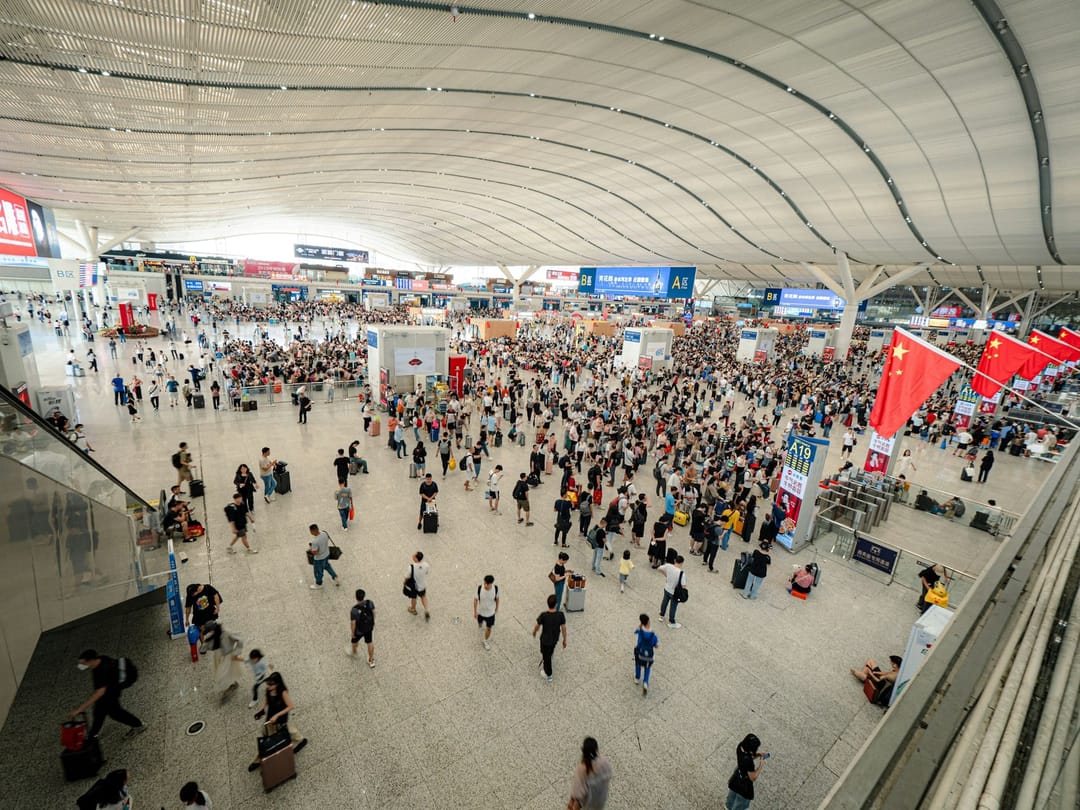
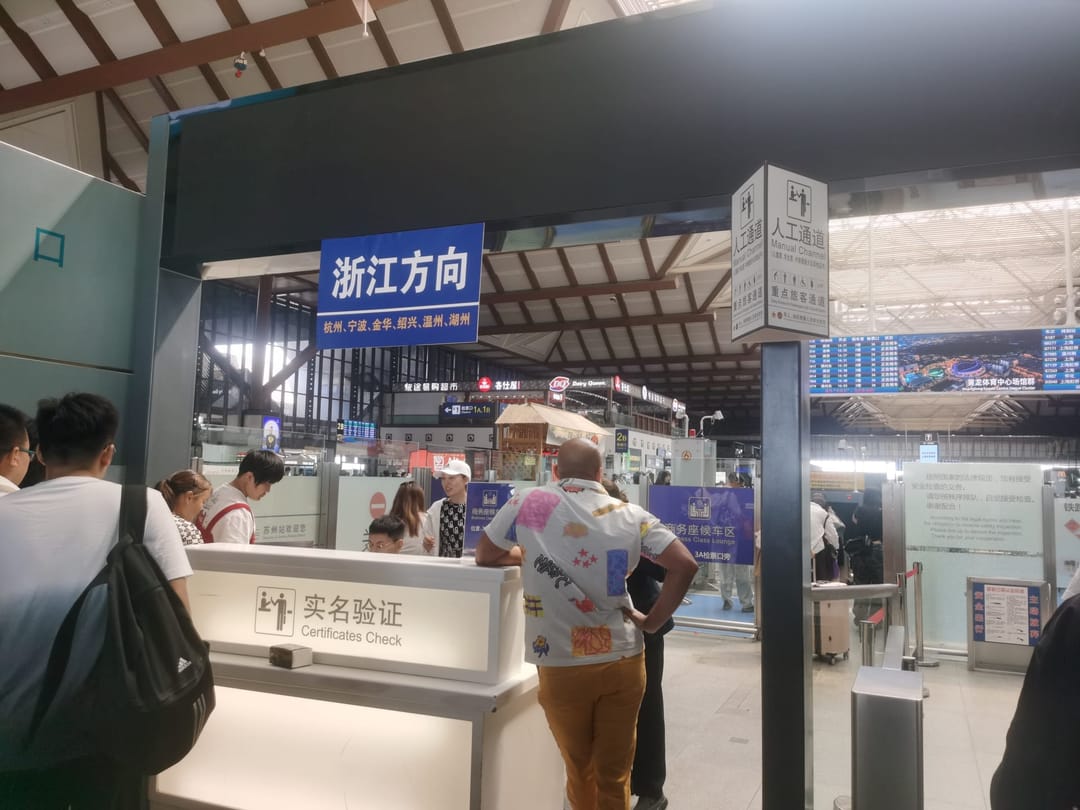
Chinese stations work more like airports than European railway halls: a security check, an identity check, a waiting area, and boarding by gate.
Find the right station
Large cities have several stations, and a ticket names one of them. Beijing South, Beijing West and Beijing’s main station are different places, and so are Shanghai Hongqiao and Shanghai’s main station. Read the station on the booking, not only the city, and check how far it is from your hotel.
Security, then the ticket gate
Bags go through an X-ray scanner at the entrance. The ticket check follows, and your ticket is the passport you booked with, under the passenger rules. 12306 sends foreign passports to the staffed lane, where an agent checks the document by hand. Some stations now read passports at the automatic gates: Beijing Qinghe does, and Beijing Tongzhou has staff type the number in, the People’s Daily reported in May 2026. Head for the staffed lane unless you see passports going through the machines.
Waiting hall and boarding
Departure boards give each train a gate number. There is no national closing time: each station sets its own and posts it, usually between 2 and 7 minutes before departure, and 12 minutes at Badaling Great Wall station, China Railway explained in a 2023 notice. Boarding starts about 20 minutes before departure at the train’s first station, and about 10 minutes before it arrives at stations further down the line. China Railway advises arriving 25 to 30 minutes early.
Keep your passport until the exit
Stations check tickets on the way out as well as on the way in, so you will need the same passport at the arrival station’s exit gates. Name, passport number and passenger must match: a mismatch counts as travelling without a ticket, with a 50% surcharge on the fare.
On board
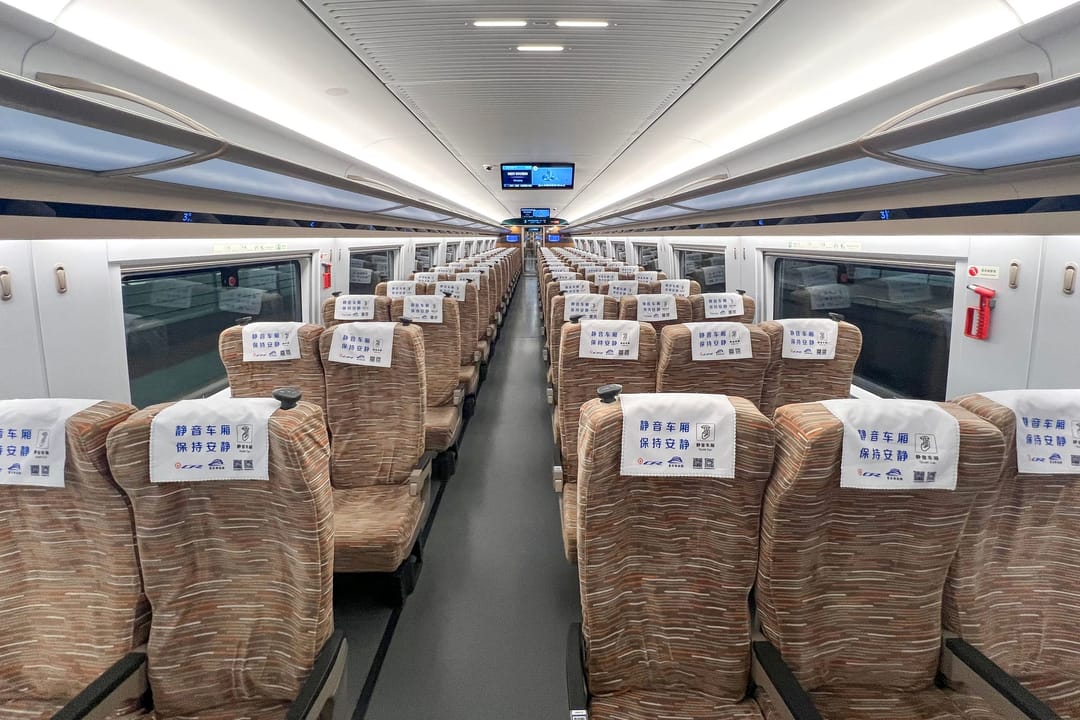
The car and seat number come with the booking. In second class, seats A and F are the window seats of the 3 + 2 rows; in first class, A and F again.
Luggage
You carry your own bags on board. The limit is 20 kg per adult and 10 kg per child, and on every high-speed train each item must measure no more than 130 cm in length, width and height added together (160 cm on conventional trains), with no single piece over 20 kg, under article 57 of the passenger rules. A 55 × 40 × 20 cm cabin case adds up to 115 cm; a large suitcase of 75 × 50 × 30 cm adds up to 155 cm, over the high-speed limit. Racks run above the seats. Power banks above 100 Wh, knives with blades over 6 cm and items with a strong smell are banned, according to the prohibited items list.
Bigger bags can travel separately. 12306’s luggage service takes items up to 50 kg, measuring 60 to 200 cm with all three sides added. Since 15 January 2026, a door-to-station service collects bags within 35 km of 111 stations for 68 yuan an item, booked in the 12306 app 48 to 4 hours before departure, The Paper reported; whether it can be booked with a foreign passport is not stated.
Food and hot water
Eating is allowed. 12306 asks passengers not to eat durian, instant noodles or other strong-smelling food, nor self-heating meals, on its dining page. High-speed trains sell set meals, and 12306 lets you order a meal to your seat in advance, paid with Alipay or WeChat Pay only, up to an hour before the train leaves the station that prepares it. Boiling water is free from a dispenser between carriages, the Chengdu railway bureau explains.
Power, Wi-Fi and the rules
Fuxing trains such as the CR400AF-Z have sockets and USB ports in every class, and 12306 limits them to phones, tablets and laptops. Free Wi-Fi runs on Fuxing trains through the railway’s own provider, CR Wi-Fi, whose login asks for a phone number; whether a foreign number is accepted is not stated, so a data eSIM is the safer plan. Smoking is banned everywhere on high-speed trains, with a fine of 500 to 2,000 yuan under the railway safety regulations and a 180-day ban on buying train tickets.
Refunds, changes and missed trains
Tickets can be refunded or changed, and the fee depends on how close you are to departure.
The refund bands
The scale has been in force since 14 January 2021, under a 12306 notice, with a minimum fee of 2 yuan.
| When you refund | Fee |
|---|---|
| 8 days or more before departure | free |
| 48 hours to 8 days before | 5% of the fare |
| 24 to 48 hours before | 10% |
| less than 24 hours before | 20% |
Updated:
Since 19 January 2026, a ticket bought by mistake can be refunded free within 30 minutes of payment, if the train leaves at least 4 hours later, once a day.
Changing a ticket
You can change a ticket once. Since 15 January 2024 a change is free more than 48 hours before departure, or to an earlier train, under the current rule. Moving to a later date costs 5% between 24 and 48 hours before departure, 15% within 24 hours, and 40% once the train has left, calculated on the cheaper of the two tickets. A missed train can be changed to another the same day without that fee.
A new passport
A ticket cannot change name after purchase: the 12306 FAQ says to refund it and buy again, with the refund fee. If China Railway cancels your train, the refund is not automatic: you claim it without a fee on 12306 or at a window within 30 days of the travel date, according to 12306’s help pages. Nothing published covers a ticket booked on a passport that has since been replaced. The ticket is the passport used to buy it, so book with the one you will carry.
Hong Kong, Tibet and trains abroad
High-speed trains run straight from Hong Kong into the mainland, and a few lines cross China’s other borders.
From Hong Kong West Kowloon
West Kowloon station had direct trains to 110 mainland stations after the timetable change of 26 January 2026, MTR announced, from Shenzhen and Guangzhou to Beijing West in 8 hours 11 minutes. For travel in mid-October 2026, second class cost 68 yuan to Futian, 215 yuan to Guangzhou South and 1,248 yuan to Beijing West on 12306. Tickets are sold on 12306, through agents and at the station, and you board with the passport you booked with. Hong Kong and mainland border controls are both inside the station, so mainland entry rules, visa-free entry included, apply there. Checks open 90 minutes before departure and close 30 minutes before, and the boarding gates shut 5 minutes before, according to MTR’s departure guide.
Sleepers from Hong Kong
Since 26 January 2026 a high-speed sleeper has left West Kowloon for Shanghai Hongqiao every evening at 20:00, arriving at 06:58, under two train numbers on different days. The Beijing West sleeper runs from Friday to Monday only, leaving at 20:25 and arriving at 06:53, on MTR’s and 12306’s timetables. Published berth prices are far above seat fares, and 12306 often sells below them.
The train to Lhasa
Foreign travellers need a Tibet Travel Permit, arranged through a travel agency, to enter Tibet, whatever the transport. The Z21 leaves Beijing West at 19:48 and reaches Lhasa at 11:46 two days later, nearly 40 hours, with hard berths at 720 yuan and soft berths at 1,144 yuan on 12306 for October 2026; from Xining, the journey takes about 20 to 22 hours.
Across the border
Three international lines run in 2026. Kunming to Vientiane in Laos takes 9 hours 36 minutes on the D87, with second class at 542 yuan on 12306, and more than 30,000 visa-exempt foreign passengers had used it by April, Guangming Daily reported. A sleeper leaves Nanning every evening for Hanoi’s Gia Lam station, arriving the next morning, and the K23 runs once a week from Beijing to Ulaanbaatar. The trains from Beijing to Moscow and from Urumqi to Kazakhstan had not resumed regular service.
Before you go
- Decide between 12306 and an agent. On 12306, register and start the identity check several days before you want to buy.
- Note the release time of your departure station, and be ready 15 days ahead for a holiday week.
- Check the station named on the ticket and how long it takes to reach it.
- Keep the passport you booked with for the whole journey, exit included.
- Paying in the apps works as described in paying in China with Alipay and WeChat Pay, and the 12306 app needs data on the move, which a data eSIM provides.
Frequently asked questions
Can foreigners use 12306? Yes. The English site accepts foreign passports, after an identity check done online or at a station window.
Is booking China trains on Trip.com legit? Trip.com books the same 12306 seats with your passport details. Its fares matched 12306 on 8 October 2026; read the checkout for any fee.
When are China train tickets released? Fifteen days ahead, counting the day of travel, at a time set by the departure station: 12:45 at Beijing South, 13:45 at Shanghai Hongqiao.
Do I need to book train tickets in advance in China? There is no early-booking discount; the risk of waiting is a full train. It is highest in holiday weeks, when booking at the release time matters.
How much are high-speed train tickets in China? Second class runs from about 550 to 660 yuan between Beijing and Shanghai and under 90 yuan between Shanghai and Hangzhou. First class costs roughly 1.6 times as much.
Is first class worth it on Chinese trains? It gives four seats per row instead of five and, on some trains, drinks and snacks. On a four-hour journey, the extra room is the main difference.
Can you eat on Chinese trains? Yes. Meals are sold on board and can be ordered to your seat; 12306 asks you to avoid strong-smelling food.
Does China high-speed rail have Wi-Fi? Fuxing trains have free Wi-Fi, but the login asks for a phone number and a foreign one may not work. Plan on your own data.
Are China train tickets refundable? Yes, free 8 days or more before departure, then for 5%, 10% or 20% of the fare.
Is there a rail pass for China? No national pass exists. Some intercity lines sell multi-ride tickets on 12306, and whether a foreign passport can buy them is not stated, so buy each journey.
Can you take a train from Hong Kong to the mainland? Yes, from West Kowloon, with direct trains to more than a hundred stations. Board with the passport you booked with: mainland border control is inside the station.
What is the difference between G and D trains? A G train is the high-speed service and the usual choice between big cities. A D train is slower and cheaper, and the overnight sleepers between Beijing and Shanghai are D trains.