China visa-free entry: who qualifies and for how long
Which passports get 30 days without a visa, why the United States is not among them, what the border actually asks for, and what happens on 1 January 2027.
In this article


Fifty nationalities can enter mainland China without a visa and stay 30 days. The arrangement is temporary, it expires at midnight on 31 December 2026, and the list is narrower than most guides suggest. American passport holders are not on it.
Every figure below names the official notice it comes from, with its date.
Who qualifies, by nationality
The unilateral visa exemption covers 50 countries. The Chinese embassy in Berlin publishes the full list in its FAQ on visa-free entry, last updated on 5 March 2026.
| Region | Countries | Including |
|---|---|---|
| Europe | 35 | United Kingdom, Ireland, Germany, France, Italy, Spain, Switzerland, Russia, Sweden |
| Asia | 7 | Japan, South Korea, Brunei, Saudi Arabia, Oman, Kuwait, Bahrain |
| Americas | 6 | Canada, Brazil, Argentina, Chile, Peru, Uruguay |
| Oceania | 2 | Australia, New Zealand |
An ordinary passport is required. Diplomatic and service passports fall under separate rules, and travel documents, temporary passports and emergency passports are excluded from the exemption outright.
Europe, 35 countries
The European block is the broadest and it does not follow EU membership. Switzerland, Norway, Iceland, Liechtenstein, Andorra, Monaco, Montenegro and North Macedonia are all on the list without being members, while the arrangement attaches to nationality rather than to residence.
Asia and the Pacific
Japan, South Korea and Brunei are covered, along with Saudi Arabia, Oman, Kuwait and Bahrain. Australia and New Zealand complete the picture for the Pacific. Brunei is the one country whose exemption carries no expiry date at all.
The Americas, and why the United States is not on the list
Six countries in the Americas qualify. Canada, Brazil, Argentina, Chile, Peru and Uruguay. The United States is absent, and that absence is the single most consequential fact on this page for English-speaking readers.
Search demand suggests most people assume otherwise. Guides that advertise "77 visa-free countries" or "79 countries" are adding three separate arrangements together: the unilateral 30-day exemption covered here, bilateral mutual-exemption treaties, and the visa-free transit scheme. The United States appears in the third of those, not the first.
What an American traveller does get is the 240-hour transit arrangement, which is real but comes with a condition most people miss. It is covered further down.
The United Kingdom and Canada, added in February 2026
Both were added in February 2026 and both appear in the official March 2026 list. British and Canadian passport holders have the same 30 days, the same permitted purposes and the same expiry date as everyone else.
If your passport is not listed
A visa applied for in advance at a Chinese embassy or consulate remains the route, matched to the purpose of the trip. Residence does not help: someone living in Berlin or Toronto on a passport that is not listed still needs a visa. The exemption follows the passport, not the address, and a permanent residence permit changes nothing.
Dual nationals should note which passport they enter on. Entering on a listed passport means leaving on the same one, because that is where the entry stamp sits.

The 30 days, counted exactly
When the clock starts
The permitted stay is counted from the day after entry and runs for 30 calendar days. Arrival day does not count. That detail moves the departure deadline by a day compared with the obvious arithmetic, in the traveller's favour, and it comes straight from the embassy FAQ.
Calendar days, not working days. Arrival time is irrelevant.
Multiple entries, no cap
The exemption can be used more than once. As things stand there is no limit on the number of entries or on total days accumulated, and no minimum interval between two visits. Each entry opens a fresh 30-day window.
The embassy pairs that with a condition: activities must match the stated purpose of entry. Anyone entering repeatedly in quick succession should expect to be asked why.
If you need longer
Thirty days is a ceiling per entry, not a starting point for negotiation. Planning a longer stay means applying for a visa before departure. Once in the country, a genuine reason allows an application for a stay permit at the exit-entry administration of the local police.
Simply staying falls under Article 78 of the Exit and Entry Administration Law: a warning, and in serious cases 500 yuan per day up to a ceiling of 10,000 yuan, or detention of five to fifteen days. Where a guardian's failure leaves a child under sixteen staying illegally, the guardian can be warned and fined up to 1,000 yuan.
.jpg)
What you need at the border
Passport validity, and the six-month myth
A great many guides state that six months of remaining passport validity is required. That is not what the rule says. The embassy FAQ asks for an ordinary passport valid for the duration of the intended stay, which is a considerably lighter requirement.
Confusing the two can cost a trip that was perfectly possible. Airlines set their own carriage conditions, which can be stricter than the entry rule itself, so the ticket is worth checking separately.
Supporting documents
Invitation letters, onward tickets and hotel bookings are recommended rather than required. The embassy advises carrying documents consistent with the stated purpose, and stops short of making them a condition of entry.
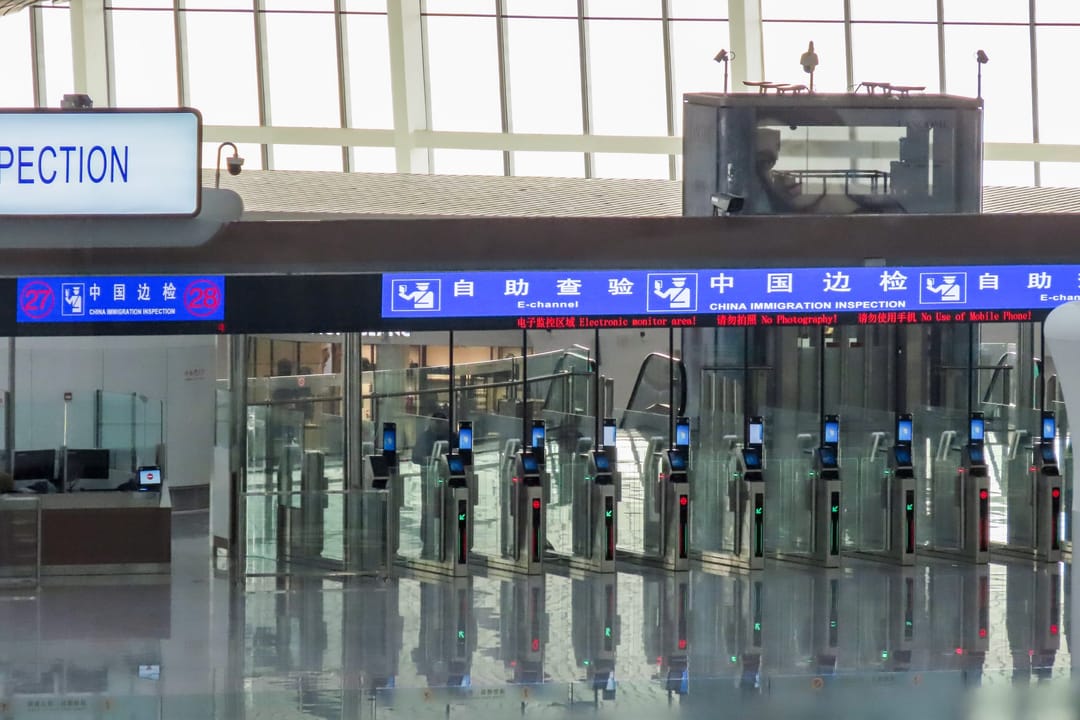
Entry is permitted at every port open to foreign nationals, by sea, by land and by air. The exemption is not restricted to airports, which matters for anyone crossing from Hong Kong, Macau or a land border. Departure may be from any third country, so a traveller flying in from Bangkok or Dubai is covered exactly as one flying from home.
The arrival card: free, and optional online
Since 20 November 2025 the arrival card can be completed online before departure. The official notice sets out several routes: in advance through the immigration administration's portal, on arrival by scanning a QR code or using a self-service terminal, or on paper as before.
Filling it in ahead of time speeds up the queue. It is not a condition of entry, and nobody is turned away for arriving without one. Seven categories are exempt altogether, including permanent residents, group-visa travellers and anyone in 24-hour direct transit who stays inside the port area.
The official address is s.nia.gov.cn/ArrivalCardFillingPC/. Scanning the QR code on
arrival needs a working data connection, and which kinds work in China without a detour
is covered under China eSIM.
Sites that charge for it
On 5 December 2025 the National Immigration Administration published a warning of its own: operators outside China have set up sites impersonating the official platform and charging fees to complete the arrival card.
The card is free. Any site asking for money is not the official one. This is the point at which travellers most often lose money before they have left home, and almost no guide mentions it.
Registering within 24 hours
This obligation has nothing to do with visas and applies regardless. It sits in Article 39 of the Exit and Entry Administration Law.
In a hotel
Guests staying in hotels need do nothing. The hotel registers them and files the details with the local police, which is why the passport is scanned at check-in. A hotel that fails to file faces the penalty, not the guest: a warning, and in serious cases a fine between 1,000 and 5,000 yuan. Moving between hotels changes nothing, because each one files afresh.
In a private home
Anyone staying somewhere other than a hotel, with friends, in a rented flat or a holiday let, must register with the exit-entry administration of the local police within 24 hours of arrival. The obligation falls on the traveller or on whoever is providing the accommodation.
This is the question I get asked most often, and it is still the one most often overlooked. It catches precisely the people who chose not to stay in a hotel. Bring the passport with its entry stamp and the address; whoever is hosting should have proof of the dwelling. The office that matters is the one where you are sleeping, not the one at your arrival airport.
What the exemption does not cover
Covered purposes
Business, tourism, visiting family and friends, exchange visits and transit. Travelling alone or in a tour group makes no difference. Sports competitions, conferences, trade fairs and study tours including summer and winter camps are covered explicitly, which is useful because none of them reads cleanly as either tourism or business.
The eight cases the embassy names
On 16 February 2026 the Berlin embassy went further and listed the cases in which visa-free entry is regularly refused:
- Learning kung fu, for instance Meihuaquan or Tai Chi
- Attending language or culture courses
- Artists performing commercially
- Taking part in TV or online show recordings, sports competitions excepted
- Filming for films, series, documentaries or advertising
- Interviews, reporting, or filming for news
- An internship
- Short-term work assignments such as teaching or modelling
The first two are the ones that surprise people. A language course or a training stay at a martial arts school reads like a holiday to most travellers and does not qualify. The embassy describes the list as guidance rather than exhaustive.
Remote work, the grey area
Working remotely for an employer outside China during a tourist stay is not addressed anywhere in writing. Anyone whose trip depends on it should not rely on an interpretation that no official notice confirms.
Transit: 24 hours and 240 hours
Transit is a separate arrangement with separate conditions, summarised by the immigration administration in an overview dated 20 August 2026.
| 24-hour transit | 240-hour transit | |
|---|---|---|
| Who | every nationality | 57 countries, including the United States |
| Where | every open port | 65 designated ports across 24 provinces |
| How long | 24 hours | 10 days |
| Movement | inside the port area only | the permitted areas |
| Ticket | confirmed onward ticket to a third country | confirmed onward ticket to a third country |
The 24-hour rule
It applies at every open port and to nationals of every country, on a valid travel document and a confirmed onward ticket to a third country, provided the traveller stays inside the designated area of the port. Leaving it requires a temporary entry permit from the border authority.
The 240-hour rule, 57 countries
Ten days, for nationals of 57 countries including the United States, the United Kingdom and Russia. Many guides still say 55 countries and 60 ports. That was the position in June 2025.
Why transit is not a substitute
The condition that decides everything is the onward ticket to a third country. A return trip from New York or London to China and back does not satisfy it.
For an American traveller this is the crux. The 240-hour scheme is not a version of the visa exemption; it is an arrangement for people passing through on the way somewhere else. It also becomes the trap of January 2027 for everyone else, once the 30-day exemption lapses.


Hong Kong and Macau count separately
Both special administrative regions run their own border control. The mainland exemption does not apply there, and theirs does not apply on the mainland.
Hong Kong
The Immigration Department admits American, Canadian, Australian, New Zealand and Irish passport holders for 90 days, and British citizens for 180. These are Hong Kong's own rules, independent of the mainland arrangement and unaffected by its expiry date.
For Americans the practical consequence is worth stating plainly: Hong Kong is open for 90 days while the mainland is not open at all without a visa.
Macau
Macau sets its own conditions, independently of both the mainland and Hong Kong. The immigration service of the Macau police is the authority on the current permitted stay, and figures quoted in guides and comparison sites are not.
What matters for planning is the structure. A trip from Zhuhai into Macau is an exit from the mainland and the return is a fresh entry. Anyone travelling Hong Kong to Macau to Zhuhai in a single day crosses two borders and clears three separate immigration controls, none of which shares a record with the others.
Returning to the mainland
Coming back from Hong Kong or Macau counts as a new entry. Since the exemption may be used repeatedly and neither the number of entries nor the total days is capped, a fresh 30-day window opens, counted from the day after re-entry.
What happens on 1 January 2027
What applies today, and until when
The exemption runs until midnight on 31 December 2026. Nothing has been announced for the period after that.
The expiry is not uniform across countries, which is rarely mentioned. Brunei's exemption carries no end date at all.
The timeline, with the notice behind each change
| Date | What was decided |
|---|---|
| 24 November 2023 | A 15-day exemption opens on 1 December 2023 for an initial year |
| later | The stay rises to 30 days and the list of countries grows |
| 3 November 2025 | Extension to 31 December 2026, midnight |
| 10 November 2025 | Sweden added |
| 20 November 2025 | The arrival card can be completed online |
| February 2026 | The United Kingdom and Canada added, bringing the list to 50 |
| 20 May 2026 | Russia extended to 31 December 2027 |
| 20 August 2026 | Transit updated to 57 countries and 65 ports |
The only precedent this year
Russia's exemption originally ran from 15 September 2025 to 14 September 2026, a deadline as tight as the one facing everyone else at the end of this year.
On 20 May 2026, roughly four months before it lapsed, the Chinese foreign ministry announced the extension, and not by a further year but to 31 December 2027.
Nothing about the other 48 countries follows from that, and nothing is being inferred here. What is known about the decision, and when it would be expected, is set out in a separate page on the extension. Two things can be stated. Decisions of this kind arrive some months ahead of expiry, and the horizon of 31 December 2027 is already in use. Anyone planning a trip for spring 2027 has a reasonable chance of knowing where they stand in good time, and should not count on it.
Worth noting as well: the Berlin embassy FAQ still shows 14 September 2026 for Russia. Official pages lag the legal position too.
Frequently asked questions
Is China visa-free for US citizens? No. The United States is not among the 50 countries covered by the 30-day unilateral exemption. Americans can use the 240-hour transit scheme, which requires an onward ticket to a third country, and can enter Hong Kong for 90 days under Hong Kong's own rules.
Is China visa-free for UK citizens? Yes. The United Kingdom was added in February 2026 and appears in the official March 2026 list, with the same 30 days per entry as everyone else.
Is China visa-free for Canadians? Yes, added at the same time as the United Kingdom and on identical terms.
Is China visa-free for Australians? Yes. Australia and New Zealand are both on the list, for 30 days per entry.
How long can you stay in China without a visa? Thirty calendar days per entry, counted from the day after arrival. Arrival day does not count.
How long must your passport be valid? For the duration of the intended stay. Six months of remaining validity is not required for the exemption, whatever many guides say. Travel documents, temporary and emergency passports are excluded.
Do you need a visa for a layover in China? No. Staying inside the designated area of the port allows 24 hours. Beyond that the 240-hour scheme covers 57 countries, but it requires an onward ticket to a third country, which a simple return trip does not provide.
Does the exemption cover Hong Kong and Macau? No. Both run their own border control. Hong Kong admits Americans, Canadians, Australians, New Zealanders and Irish citizens for 90 days and British citizens for 180; Macau sets its own terms.
Do you have to register with the police in China? Only if you are not staying in a hotel. Hotels file the registration themselves. Anyone in a private home or rented flat must register with the local police within 24 hours of arrival.
What happens if you overstay? Article 78 of the Exit and Entry Administration Law provides for a warning and, in serious cases, a fine of 500 yuan per day up to 10,000 yuan, or five to fifteen days of detention. A stay permit can be applied for at the local exit-entry administration where there is a genuine reason to remain.
Read next
China eSIM: what a local SIM commits you to
A Chinese SIM card is a registered identity, kept for two years after you cancel. A travel eSIM is a foreign subscription. That difference is legal, not technical.
Will China's visa-free policy be extended? What is known
The exemption expires on 31 December 2026 and nothing has been announced for after. What the one precedent this year actually shows, and how to check for yourself.