Destinations · Chengdu and the south-west
18 things to do in Chengdu: pandas, teahouses, Leshan Buddha
Chengdu in three to five days: the Panda Base and its winter hours, the other panda bases, teahouses, museums, Sichuan opera, Leshan, Emei, getting around.
thechinaatlas.com/en/chengdu
In this article
Chengdu takes three days: a morning at the Giant Panda Base, ideally from the opening, and two days for the teahouses, temples and museums of the centre. A fourth day fits the Leshan Giant Buddha, under an hour away by train, and a fifth Sanxingdui, Dujiangyan or Mount Emei. Book the Panda Base before anything else, in your own name with your passport: from November to February its morning entry opens at 8:00 and staff start clearing the park at 17:30.
Central Chengdu and the Panda Base
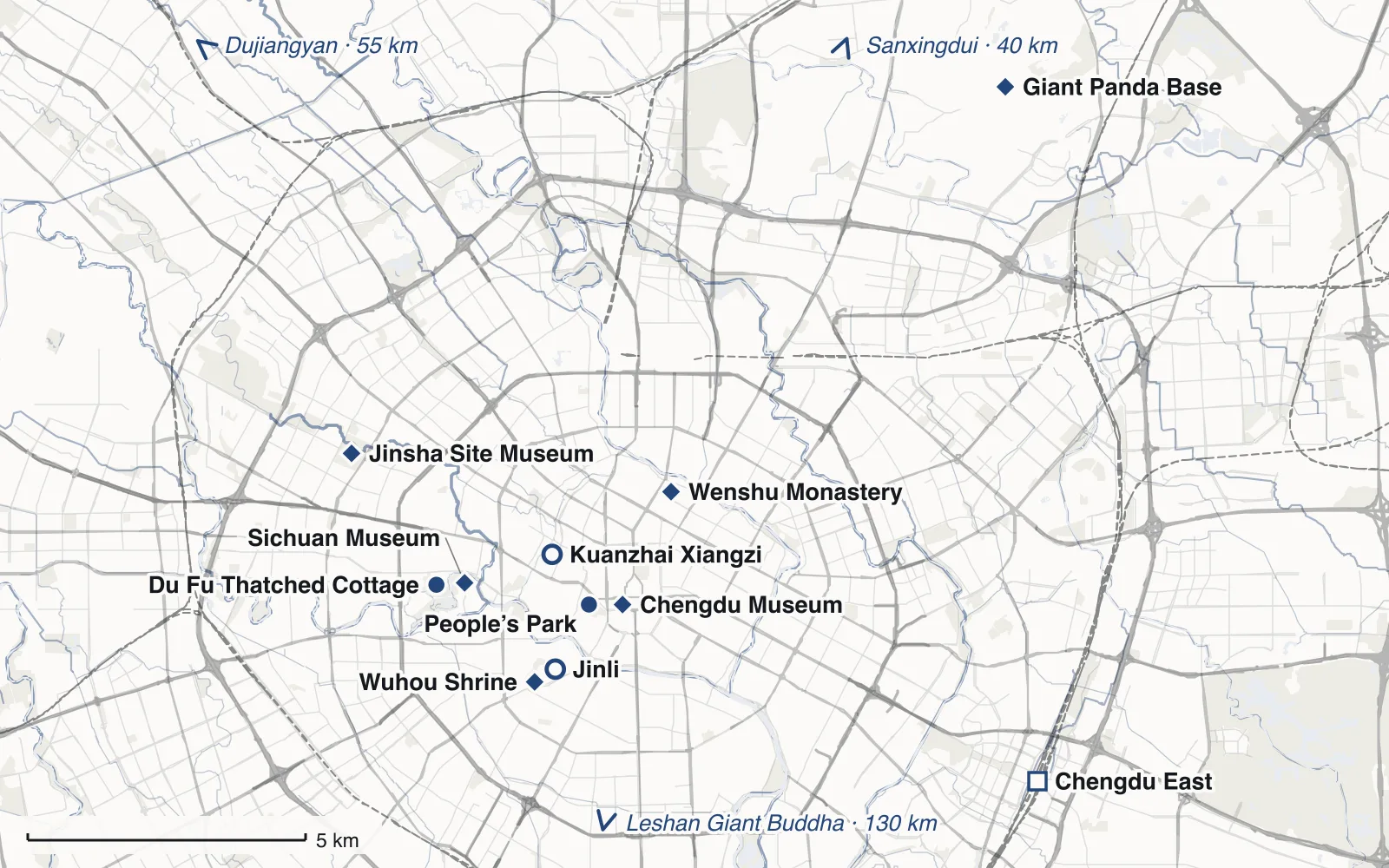
- Garden or park
- Sight
- Old street
- Station
Map: The China Atlas · Data: © OpenStreetMap contributors, © OpenMapTiles, OpenFreeMap
How many days do you need in Chengdu?
Three days cover the city. The Panda Base takes a morning, and the rest of that day suits the Wenshu Monastery and People’s Park, both in the centre and both free. A second day can go to the Wuhou Shrine, Jinli and the Du Fu Thatched Cottage, a third to the Sichuan Museum or the Chengdu Museum, with an evening of Sichuan opera. Both museums close on Mondays, so a Monday is better spent with the pandas or out of town.
Each extra day buys one trip out. Leshan is 41 to 53 minutes away by train, with 69 trains a day on the national railway timetable and the last one back at 22:12. Sanxingdui is about 20 minutes by train to Guanghan North, then a short taxi ride. Dujiangyan and Mount Qingcheng share a day from Xipu, at the western end of metro line 2. Mount Emei as far as the Golden Summit makes a very long day, and a night at the foot of the mountain is easier. Jiuzhaigou is a separate trip of two nights at least: the train takes 1 h 39 at best, the bus to the park another two hours, and the gates stop admitting visitors at 14:00.
On a longer route, the three-week China itinerary gives Chengdu three nights, between Xi’an, 3 h 05 away by train, and Guilin, just under five hours.
What to book before you go
Most sights take a real-name booking, made online with your passport number, and several ask visitors without a Chinese ID card to swap it for a paper ticket at a window. Outside public holidays little sells out; over the October 2026 holiday, the Sanxingdui Museum announced that every ticket for the first five days had gone.
| Site | How to book | Adult price | Closed |
|---|---|---|---|
| Giant Panda Base | Official WeChat account or Trip.com, up to 14 days ahead | 55 yuan | Never (Villa No. 6 on Mondays) |
| Wuhou Shrine | Official website or WeChat account, 14 days ahead | 50 yuan | Never |
| Du Fu Thatched Cottage | WeChat account, 14 days ahead | 50 yuan | Never |
| Sichuan Museum | WeChat account, up to the following Sunday | Free | Mondays |
| Chengdu Museum | Online, 14 days ahead | Free | Mondays |
| Sanxingdui Museum | Website or WeChat, 5 days ahead, from 20:00 | 72 yuan | Chinese New Year’s Eve |
| Leshan Giant Buddha | Mini-program 大佛旅游 on WeChat or Alipay | 80 yuan | Never |
| Mount Emei | Timed booking on the official account | 160 yuan, bus 90 | Never |
| Dujiangyan | Official WeChat accounts, up to 15 days ahead | 80 yuan | Never |
Updated:
Visitors over 60 are where the rules differ. The Panda Base lets them in free without booking and sets no nationality condition, with the passport on its list of accepted documents. The Wuhou Shrine and the Du Fu Thatched Cottage grant free entry at 60 to Chinese ID cards and foreign permanent residents only, so a foreign tourist pays the full 50 yuan.
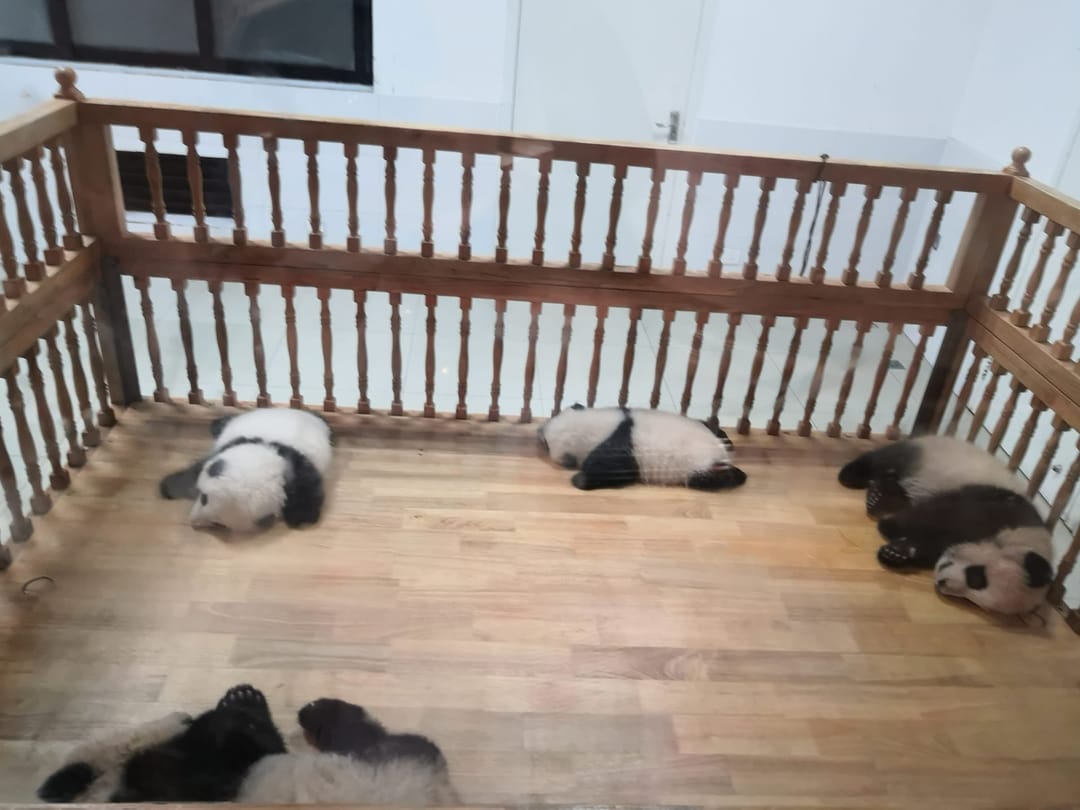
The Giant Panda Base
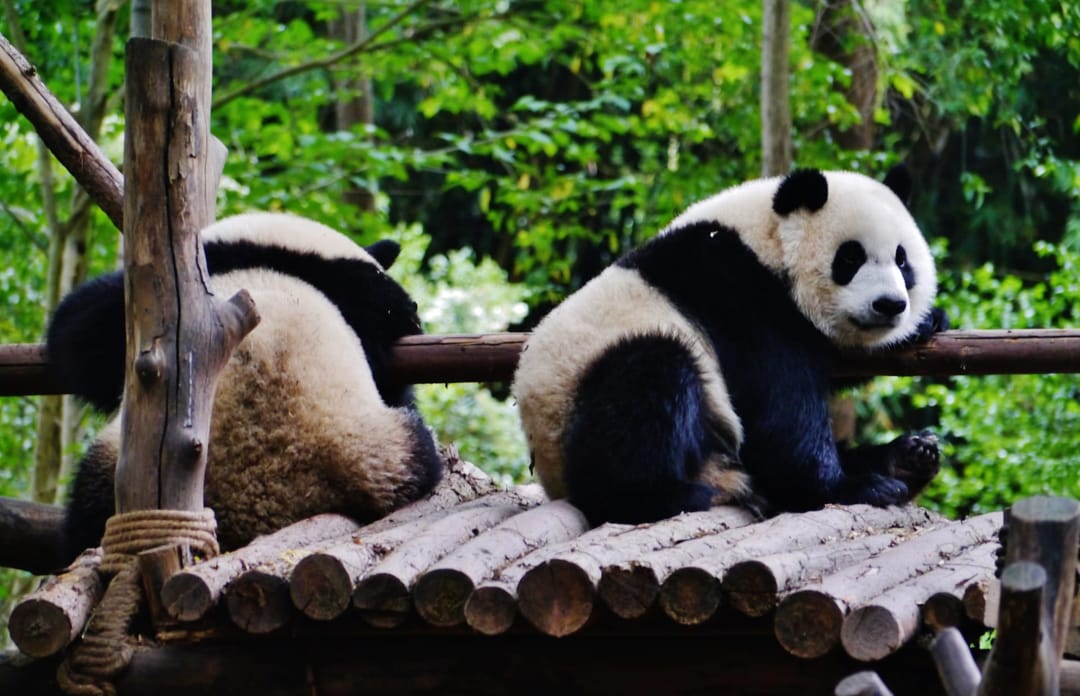
The Chengdu Research Base of Giant Panda Breeding started in 1987 with six pandas rescued from the wild, China Daily recalls. It kept more than 240 at the end of 2024, by the state broadcaster CGTN’s count, on 238 hectares in the north of the city.
Tickets and winter hours
Adults pay 55 yuan and students 27; children aged six and under, or under 1.3 m, enter free without booking, as do visitors over 60. Everyone else books up to 14 days ahead, on the base’s WeChat account or through the agencies it authorises, Trip.com among them, which the English ticket page links to directly. The ticket covers a half-day at the same price morning or afternoon, and afternoon holders are asked not to arrive early.
Summer hours ended on 31 October 2026. From 1 November to 28 February, under the base’s winter notice of 16 October, the morning entry runs from 8:00 to 12:00, the afternoon one from 12:00 to 16:30, and the park clears from 17:30 instead of 18:00. The base takes up to 85,000 visitors a day. I would take the morning slot, when the pandas are feeding outdoors.
At the gate, a passport is scanned in the lane for original documents. Without it, a photo of your own ID gets a manual check in the other lane, and the name must match the booking.
Getting to the base
The base’s transport page gives metro line 3 to Panda Avenue, exit A, then shuttle bus 408 to the south gate, or line 3 to Junqu Zongyiyuan, exit B, and shuttle 409 to the west gate, about ten minutes. A taxi costs about 40 yuan from Chunxi Road or from Chengdu East station, 25 to 35 minutes, and about 200 from Tianfu airport. On busy days the base directs visitors to the west gate, which has no car park.
Inside the park
The park has two halves. The original south part holds the villas and the Sunshine and Moonlight nursery houses. The western expansion, opened on 1 January 2022, added eleven panda houses on wooded hills and in a valley, with larger yards and fewer viewing points per house, China.com.cn reported at the opening, along with the Panda Tower and the Star nursery. Cubs are born from July to September, and the base put its 2026 cubs on public view at the end of September, CCTV reported. The 2025 cohort had made its debut in the Star and Moonlight nurseries in February 2026, after the base and the national conservation centre bred 45 cubs between them that year, according to Xinhua.
A sightseeing cart between the two gates costs 30 yuan for the day, and an audio guide in English another 30. In warm weather the base keeps the pandas in shade or brings them indoors, into villas and nursery halls with indoor viewing. Villa No. 6 closes every Monday, a rest day for the animals introduced in December 2023, and so does the Panda Art Museum. Flash, feeding, drones and scooters are banned, with a lifetime ban for the worst cases.
Can you hold a panda?
No. Since 23 October 2018, Sichuan’s forestry department has banned paid photos, feeding and any commercial close contact at every captive-panda institution in the province, including when it is sold as volunteering, China Daily reported. Only keepers, vets and researchers get close.
The Chengdu base recruits its own volunteers for the long term: written Chinese, at least 60 hours of service after training, and no contact with animals. The volunteer days sold by agencies take place at the national centre’s bases, where visitors clean enclosures and make panda bread; the best known, at Dujiangyan, is closed for renovation.
Other panda bases near Chengdu
Four more panda bases lie within reach of the city, and the two at Dujiangyan are easy to confuse: they belong to different institutions.
Dujiangyan Panda Valley
The Chengdu base’s wild-training centre lies in a forested valley about 50 km from the city. Open to the public since 20 April 2015, it keeps 12 giant pandas and 20 red pandas by its own count. Entry costs the same 55 yuan, on a separate ticket booked on the 熊猫谷 WeChat account, since Chengdu tickets are not valid there. Its winter hours last longer, from 1 November to 30 April, with entry from 8:00 to 16:30.
China Giant Panda Garden, Dujiangyan
The national centre’s Dujiangyan base, home to its old and sick pandas, has been closed since 23 April 2026 for renovation, with no reopening date. Its volunteer programme is closed with it.
Bifengxia, Ya’an
The national centre’s Ya’an base sits in the Bifengxia gorge, about 128 km from Chengdu, and keeps more than 60 pandas; its first twins of 2026 were born there on 10 June. D trains run from Chengdu to Ya’an, then a minibus covers the last 12 km. A combined ticket with the gorge costs about 95 yuan booked a day ahead, by the local listings site Bendibao.
Wolong Shenshuping
The Shenshuping base, in the Wolong area of the Giant Panda National Park, has bred 199 cubs and saw the national centre’s first birth of 2026, on 4 June. It is about an hour and a half by car from Chengdu on a mountain road, and has closed several times since December 2024 for works or snow, so check the day before. Booking goes through its WeChat account, about 85 yuan.
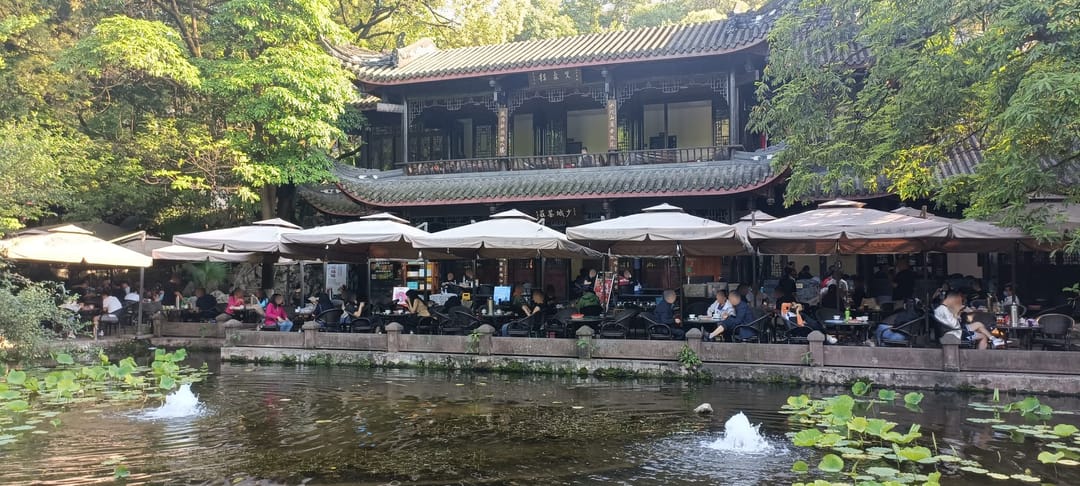
Temples and teahouses in the centre
People’s Park and the Heming teahouse
People’s Park has been free since 1 May 2004, by its official site, and sits on metro lines 2 and 17. The Heming teahouse by its lake dates from 1923. Its early tea, from 6:30 to 8:30, costs 3 yuan a cup of jasmine tea, Sichuan Online reported in 2025; later in the day, two bowls of green maofeng came to 32 yuan in a New Beijing News report, which put the ear cleaners working between the tables at 30 yuan, plus 20 for the tools.
Kuanzhai Xiangzi
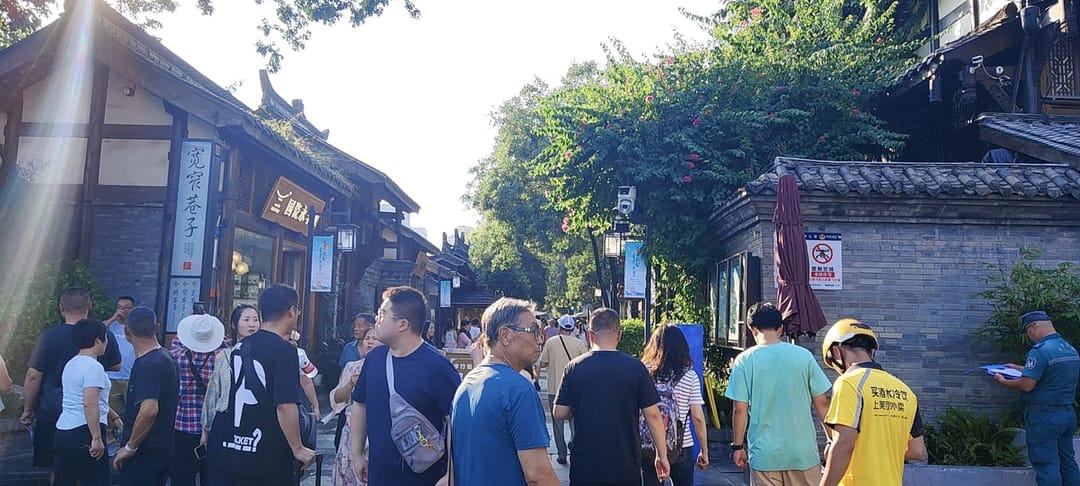
The three Wide and Narrow Alleys, Kuan, Zhai and Jing Xiangzi, are free and open all day, on metro line 4 at Kuanzhai Xiangzi station. Shops, snack counters and teahouses fill the grey-brick courtyard houses on either side.
Wenshu Monastery
Entry is free and incense is handed out at the gate. The monastery opens at 8:00 and closes in the late afternoon, at 16:30 by the latest local listing. A teahouse and a vegetarian restaurant work inside, and metro line 1 stops at Wenshuyuan, exit K, about 300 m away.
Wuhou Shrine and Jinli
The shrine to the Three Kingdoms chancellor Zhuge Liang costs 50 yuan, from 9:00 to 18:00 with last entry at 17:00, on its official ticket page; under-18s enter free after exchanging the booking at the service window. It drew 15.27 million visitors in 2025. Jinli, the lantern-hung street next door, is free, and its lights come on at about 20:00. Metro line 10 stops at Wuhouci (Jinli), exit A2.
Du Fu Thatched Cottage
The park around the poet’s reconstructed cottage costs 50 yuan, from 9:00 to 18:00, every day. Bookings open 14 days ahead on its WeChat account, and anyone without a Chinese ID card collects a paper voucher at the window, its booking page says. Line 13, opened on 16 December 2025, stops at Dufu Caotang, exit C2, by the north gate. The Daoist Qingyang Palace, 10 yuan, is close by at Qingyanggong station on line 5.
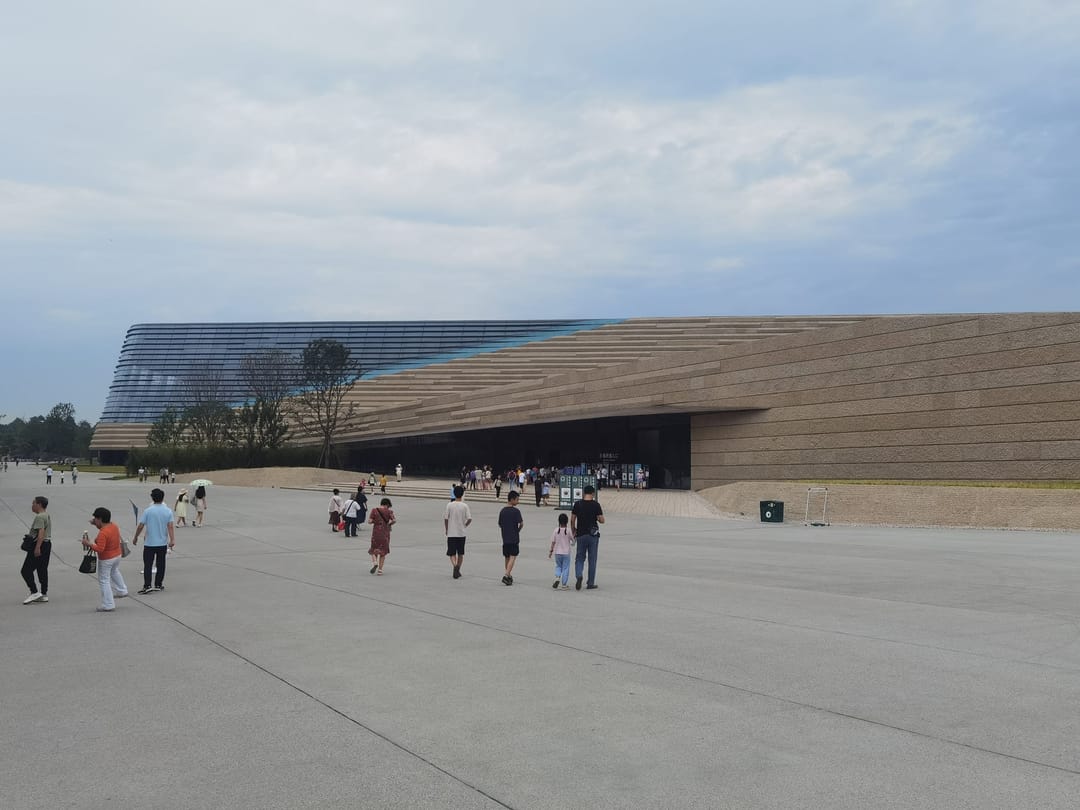
Museums in and around Chengdu
Sichuan Museum
Free, but booked on its WeChat account, open from 9:00 to 17:00 with last entry at 16:00, and closed on Mondays. Its visitor entrance is on Qinghua Road, the street of the Du Fu Thatched Cottage’s north gate, so the two fit in one day.
Chengdu Museum
On the west side of Tianfu Square, at the crossing of metro lines 1 and 2, the city museum is free with a booking and closed on Mondays. It stays open until 20:30 on Fridays and Saturdays, by its visitor guide, and admits up to 20,000 people a day.
Sanxingdui Museum
The bronze masks of Sanxingdui, in Guanghan north of Chengdu, have a new main hall, opened on 27 July 2023, where about 600 objects went on show for the first time, more than 300 of them from pits dug between 2020 and 2022, the Chinese Social Sciences Net reported. Entry costs 72 yuan, from 8:30 to 18:00 with last entry at 17:00, every day except Chinese New Year’s Eve. Bookings open at 20:00, five days ahead; foreign visitors may be asked to show the passport at the ticket centre. Trains from Chengdu East reach Guanghan North in about 20 minutes, and a direct bus from Chunxi Road, 25 yuan, took about 90 minutes in 2023 and 2024.
Jinsha Site Museum
Closed. The museum of the Jinsha site, where the gold Sun Bird ornament was found, shut on 5 December 2025 for its first full renovation and stays closed until 30 April 2027, park included. Some of its pieces are shown meanwhile at the Sichuan Museum, the Chengdu Museum and Sanxingdui.
Sichuan opera and face-changing
The Jinjiang Theatre, near Chunxi Road, reopened on 10 July 2026 after eight months of works. Its 70-minute face-changing show costs 78, 128, 168 or 298 yuan, the city government’s account announced at the reopening, booked on the mini-program of the Chengdu Sichuan Opera Research Institute or at the box office; show times vary from day to day, so check them there. The Yuelai teahouse next door stages classic excerpts on Saturdays at 14:00, for 40 to 80 yuan with a bowl of tea.
Shufeng Yayun, in the Culture Park, plays every evening from 20:00 to 21:30, with tea included, at 80 to 260 yuan by seat according to ticket agents. Its programme strings together face-changing, fire-spitting, a rolling-lamp act, hand shadows and puppets: a variety bill, where the Yuelai matinee sticks to classic excerpts.
Day trips from Chengdu
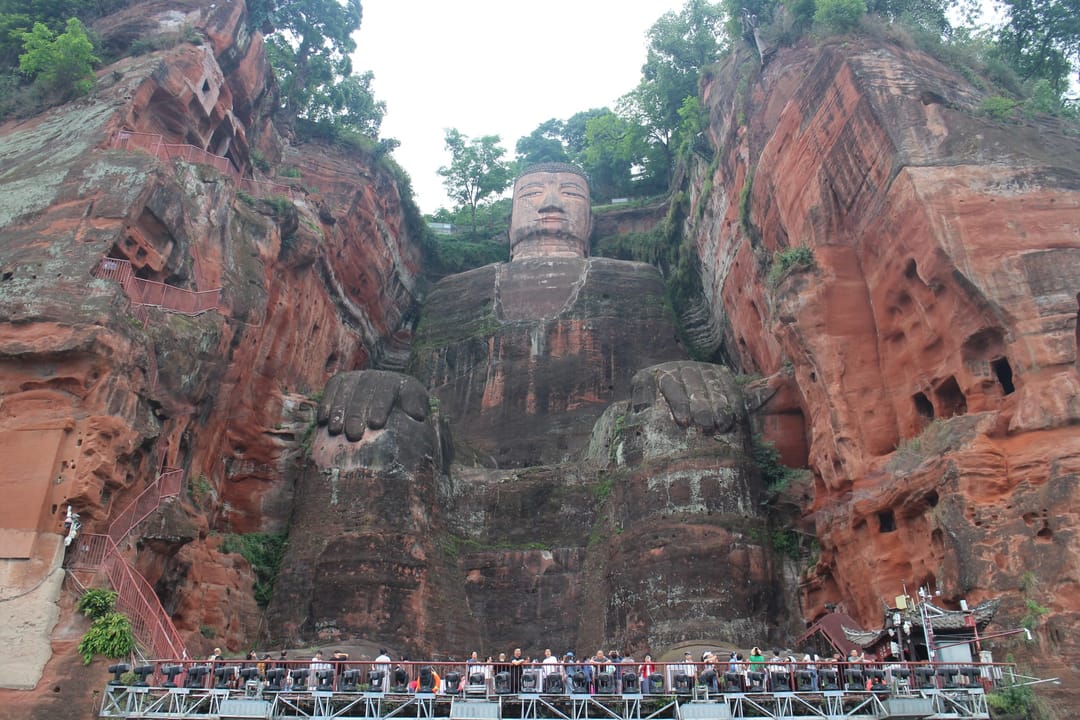
Leshan Giant Buddha
Trains to Leshan leave from Chengdu East and Chengdu South, 51 to 54 yuan, and buses K1 and 3 run from Leshan station to the scenic area, about 30 minutes. The mountain ticket costs 80 yuan and the river boat, a separate product, 70. Winter hours, from 8 October to 31 March, run from 8:00 to 17:30, the pattern published in 2021, 2024 and 2025, and bookings go through the 大佛旅游 mini-program.
Since January 2020 the walk to the Buddha’s feet runs one way: down the Lingyun Plank Road, then back up the Nine-Turn Plank Road, 278 steps and 70 metres of climb, which only goes upwards, People’s Daily reported when the loop was reversed. The route to the feet has closed for conservation work before, in May 2024 and April 2025, and the queue on public holidays can last one to two hours.
Mount Emei
High-speed trains reach Emeishan station in 1 h 05 to 1 h 09 at best, 31 a day, for 62 to 65 yuan; the last one back leaves at 19:56. The mountain ticket costs 160 yuan from 16 January to 14 December and 110 over the following month, is valid for 48 hours, and the mountain’s 20-odd temples stopped charging their own entry on 1 January 2026. Private cars are barred from the road up, so the summit means the 90-yuan return bus to Leidongping.
Works change the summit until 2027. Since 23 May 2026 the Golden Summit area takes 8,000 visitors a day, Leidongping station is closed for rebuilding and the summit cable car runs at reduced capacity while it is upgraded, the listed operator disclosed; buses to Leidongping sold out a day ahead in October 2026. The macaques on the mountain are protected, and feeding them is banned: in May 2026 a visitor who pushed one was barred from the mountain for three years, Xinhua reported.
Dujiangyan and Mount Qingcheng
Trains to both leave from Xipu, not from the main stations. On the national railway timetable, 39 suburban trains a day run from Xipu to Qingchengshan, 06:03 to 22:11, in about half an hour, and 20 to Lidui Park, for the irrigation system, all for 10 yuan. No train links the two; bus 101A does, in about 70 minutes. Both sites take real-name bookings up to 15 days ahead in timed slots, with daily caps of 48,000 at Dujiangyan and 24,000 at Qingcheng, the city government announced in April 2026; cable cars are extra. Dujiangyan costs 80 yuan, Qingcheng’s front mountain 80 by most listings.
Jiuzhaigou
Huanglong Jiuzhai station, at 2,977 m, opened on 30 August 2024, the Sichuan government announced; 15 trains a day reach it from Chengdu, for 130 to 143 yuan, and the park is another 90 km by bus. From 16 November, entry and the park bus cost 80 yuan each instead of 190 and 90.
What to eat in Chengdu
Chengdu has been a UNESCO Creative City of Gastronomy since 2010. Several of the best-known Sichuan dishes have a Chengdu address: mapo tofu goes back to the Chen Mapo restaurant of the late nineteenth century, Zhong dumplings in red chilli oil to 1893, Long chao shou wontons to 1941, and fuqi feipian, cold slices of beef and offal, to a Chengdu couple of the 1930s. Dan dan noodles are claimed by both Chengdu and Zigong.
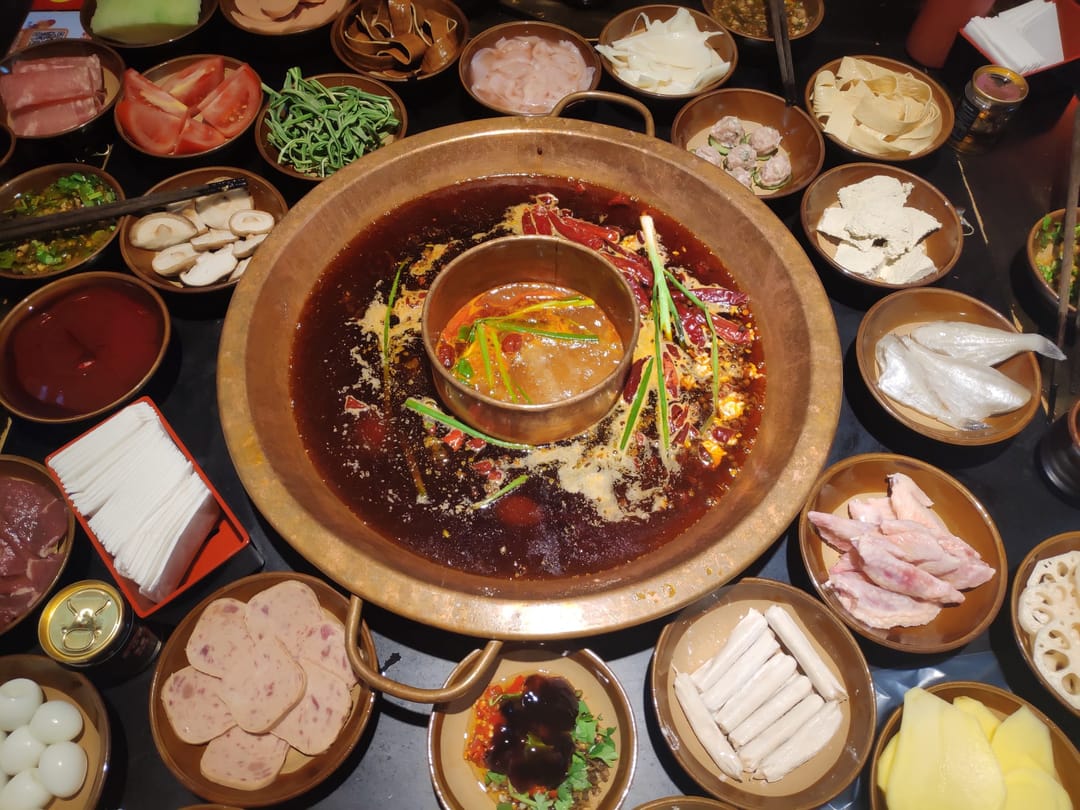
Hotpot costs roughly 80 to 120 yuan a head in a mid-range restaurant, by the prices of the main chains and a 2025 Red Star report on a solo diner. The menu offers three heat levels, 微辣, 中辣 and 特辣, mild, medium and extra hot, with no binding standard behind them: China National Radio noted in 2023 that the Sichuan hotpot association was only studying one. A split yuanyang pot, half chilli and half a plain broth of tomato or mushroom, solves the question for a mixed table. How to order without speaking Chinese is explained in the guide to what to eat in China.
Where to stay in Chengdu
Chunxi Road and Taikoo Li* form the commercial core, on metro lines 2 and 3 at Chunxi Road station. Airport bus line 1 from Tianfu ends there, round the clock, for 15 yuan by day and 25 at night, and the Daci Temple, free, stands inside Taikoo Li. Kuanzhai Xiangzi and People’s Park are a short ride west, on lines 4 and 2, and Wenshu north, on line 1. Luomashi, between Wenshu and Kuanzhai, is the interchange of lines 1 and 4. For an early flight from Tianfu, the area around Chengdu South station, where line 18 starts, saves the change.
Star hotels in Chengdu averaged 400 yuan a night in the summer of 2024, by the culture and tourism ministry’s figures: 313 for four stars and 290 for three. The China trip cost guide compares them with the other cities. The guide to where to stay in Chengdu compares the areas, with the metro to each sight, hotels and December prices.
Getting to Chengdu and getting around
Airports
All flights from Europe use Tianfu (TFU), 51 km south-east of the centre, which took over the international routes in March 2023. This winter Air China flies to London Heathrow and Gatwick, Frankfurt, Milan, Paris and Brussels, though some dates are cancelled, so check the day you want; Sichuan Airlines flies to Rome, and Turkish Airlines opens Istanbul to Tianfu on 11 November 2026, three times a week. Since 30 July 2026, most flights from Hong Kong, Macau and Taipei land at Shuangliu (CTU) instead, 16 km south-west, so a connection through Hong Kong may mean the other airport. Express trains on line 19 link the two in about 30 minutes.
From Tianfu, metro line 18 runs to Chengdu South for 10 yuan, from 6:00 to 23:30, in about 37 minutes on the express trains added in 2023; change to line 1 for Tianfu Square. From Shuangliu, line 10 runs to Taipingyuan, where line 3 continues to Chunxi Road.
Visa-free transit
Both airports are ports for the 240-hour visa-free transit, Tianfu since 17 December 2024, by the National Immigration Administration’s notice. Arrivals at Chengdu may stay in 11 cities of Sichuan, which include Leshan, Emei and Ya’an but not the Aba prefecture, so Jiuzhaigou and Wolong are out of bounds, and may continue to Chongqing. Readers who can enter without a visa at all will find the rules in the visa-free guide.
Trains
Chengdu East, on metro lines 2 and 7, is the main high-speed station: trains from Xi’an arrive in 3 h 05 at best, from Chongqing in 1 h 02. Towards Kunming, gateway to Yunnan, the fastest takes 5 h 51, and the 15 direct trains a day to Guilin all leave it before 12:40. Chengdu South, on lines 1, 7 and 18, shares the Leshan and Emei trains, and Xipu handles Dujiangyan. The new Tianfu railway station is not due before the end of 2026. Booking from abroad is covered in the guide to China train tickets.
Metro
Chengdu Metro counted 18 lines and 758 km in June 2026. Trains run from about 6:00 to 23:00, and fares go from 2 to 12 yuan by distance. Since 28 July 2025, Visa, Mastercard and American Express cards work by tapping at every gate, Xinhua reported, at the base fare; Alipay with a foreign card has generated a ride code since 2023. Day tickets cost 20, 50 and 70 yuan for one, three and five days, and no passport is needed to ride. The rest of the payment question is in the guide to paying in China.
When to go to Chengdu
Spring and autumn are the comfortable seasons. November averages 12.2 °C at Chengdu’s station in the WMO’s 1991 to 2020 normals, with highs around 16 °C, lows around 10 °C and 15 mm of rain over four wet days. July and August are hot and wet, with highs of 30 °C and 232 and 217 mm of rain; June to September bring three quarters of the year’s total.
The sky is the drawback. The same normals give Chengdu 962.7 hours of sunshine a year against 2,490.5 for Beijing, and 53 hours in November, under two a day. The Tang writer Liu Zongyuan already wrote that south of Shu, the old name of the region, it rained so often that dogs barked when the sun came out. Public holidays weigh more than the weather: in October 2026, the buses up Emei and the tickets at Sanxingdui sold out. The best time to visit China sets the holiday weeks out month by month.
Frequently asked questions
Is Chengdu worth visiting?
Yes, for the Panda Base above all, and for teahouses, temples and Sichuan food that easily fill three days. Leshan and Sanxingdui each add a day out.
Which panda base should I visit from Chengdu?
The Chengdu base for a first visit: it is in the city, has the most pandas on show and takes a morning. Dujiangyan Panda Valley suits a quieter visit to a dozen pandas in a forest valley, combined with the irrigation system. Bifengxia and Wolong are each a full day by road, and the China Giant Panda Garden at Dujiangyan is closed.
Can I book the Panda Base without WeChat?
Yes. Trip.com is one of the sellers the base has approved, and the link sits on its page in English. Pick the passport as your document type and type the number exactly as printed.
Is the Chengdu Panda Base ethical?
It is a breeding and research centre that began with rescued animals, and its visitor rules follow from that: no contact since 2018, a weekly rest day for one of its villas, pandas moved indoors in the heat. The wild population counted 1,864 animals in the last national survey, at the end of 2013, and the IUCN moved the species from endangered to vulnerable in 2016.
Is Chengdu expensive?
Less than Beijing or Shanghai. A three-star hotel averaged under 300 yuan in summer 2024, the Panda Base costs 55 yuan, most temples and two of the main museums are free, and a metro ride rarely passes 5 yuan within the centre.
Do I need cash in Chengdu?
Rarely. A foreign contactless card opens the metro gates, and Alipay or WeChat Pay with a linked foreign card covers shops, taxis and restaurants. Why a few hundred yuan in cash still earn their place is set out in the guide to paying in China.
How far is Chengdu from Chongqing and Xi’an?
By high-speed train, 1 h 02 to Chongqing for 148 to 166 yuan, and 3 h 05 to Xi’an for 263 to 316 yuan, from Chengdu East. Both routes run dozens of trains a day.
Can I visit Jiuzhaigou during a 240-hour transit through Chengdu?
No. Jiuzhaigou and Huanglong lie in the Aba prefecture, outside the 11 Sichuan cities open to transit passengers. Leshan, Emei, Sanxingdui and Bifengxia are inside.
Why is the sky in Chengdu so often grey?
Chengdu lies in the Sichuan Basin, a lowland closed in by mountains, and records fewer than 1,000 hours of sunshine a year. Beijing gets about two and a half times as much, and more than three times as much in November.
What is Chengdu famous for?
Pandas, teahouses and Sichuan food, hotpot first. On a hotpot menu, wei la, 微辣, is the mildest of the usual three heat levels, but there is no standard, and a Chengdu mild can still be fierce for a first-timer. Ask for a non-spicy broth or a split pot.
Can you see baby pandas in Chengdu?
Yes. The Chengdu base keeps its youngest animals in three nursery houses, Sunshine, Moonlight and Star, all with indoor viewing, and showed the cubs born in summer 2026 from late September.
When does the Chengdu metro stop running?
Around 23:00 on most lines, and 23:30 on line 18 to Tianfu airport. Service runs later on the eve of public holidays and on their last two days.